Monday, July 15, 2013

Monet's Art Final, Part 3: Poetry, Fountain, and Conclusion

Hey readers,

This is the final part of my essay on art.

I arrived at college with the lessons I had learned in high school as well as the experiences from art class as a boy, well aware that I understood art from a historical perspective but I was in no way an artsy type of person. My only foray into the college artistic community was when I joined the slam poetry team, pretty much as a way of working on my creative writing. I was not an obvious candidate from the start - I write much more prose than poetry, and the subject material of the average slam poem - discrimination, violence, poverty - is pretty far off from anything I write. Surprisingly, I was asked to join not only the group but the performance team. While my humorous retrospectives on relationships and being a nerd were not standard slam poetry fare, people seemed to like them. To make a long story short, however, I left the group part of the way into my sophomore year. I was annoyed that I could spend two weeks refining a poem on political violence in Zimbabwe only to have it mercilessly shot down, and then scribble down some thoughts I had on relationship drama at 1 AM and have it be a smash hit. I imagine this is what teen idols feel like when their first role in a serious drama gets panned.

At the same time, through the poetry group, I met a number of the artsier people at college, which contributed to my disillusionment with modern art and poetry as artistic mediums. In AP Art History, there was a sort of unspoken truth: there are the great artists, whose works end up in hulking textbooks about art and are displayed in world-famous museums, and then there are the other people, who try their hand at art, but are ultimately unsuccessful for a variety of reasons. Perhaps they are a painter who makes nice but not terribly original landscapes that they'll sell in an art gallery in Hawaii. Or, like the student in the first part of this essay, they are someone who puts a condom on the Virgin Mary and explains how it's this commentary on the Immaculate Conception and other religious/social stuff. I met more of the latter category in college and found myself inexplicably irked by them.  I overheard one poet talking about her latest project for sculpture class; I do not remember the exact details, but I do remember her saying something like, "I found a Barbie doll the other day half-buried in the dirt, so I dug it up, and now I'm adding it to my sculpture." My not-terribly-sophisticated response was to inwardly wonder how she could be earning the same degree I was (albeit with a different major), since I couldn't fathom how a half-buried Barbie doll was in any way related to a 15-page paper on Ukrainian foreign policy. Looking back, I could argue that neither is supposed to related to a larger audience, but at the time, my main objection to it was that it seemed to lack any sort of intellectual thought. Then again, maybe the artwork had some sort of meaning I failed to comprehend.

Neither this frustration nor any of my experience explains why I like Marcel Duchamp's Fountain. For those who aren't familiar with this iconic Dadaist work, here is a picture:
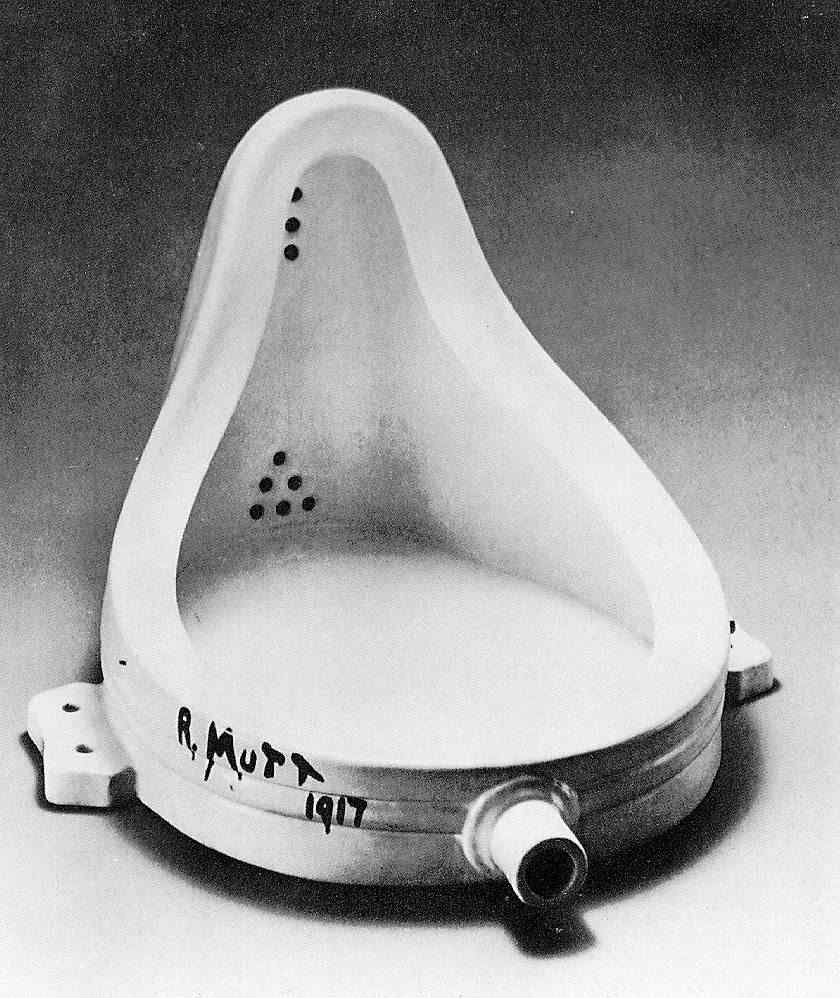


For anyone who cannot tell, that is a urinal, set on its side and labeled "R. MUTT 1917." Now, dear readers, I know you're probably thinking that it's unfair for me to dislike contemporary art, like a Virgin Mary covered by a condom, yet enjoy Fountain. After all, this required basically no work, other than Duchamp signing the urinal. However, Duchamp did not create Fountain with some sort of hidden meaning or social commentary. It was meant to be art against art - if anything it was a critique of the people who would take something like this and dream up some kind of meaning for it, as well as a move to deflate the ego of artists who considered themselves brilliant just for being artists. Duchamp was barred from exhibiting Fountain at the Society of Independent Artists show, even though he was a board member, and the only requirement to exhibit a piece was to pay the entry fee. He resigned in protest, and attended the show with Fountain tucked under his arm, eagerly showing it to anyone who was curious. Fountain was designed to piss people off (pun intended). It was never intended to be celebrated for any sort of aesthetic beauty or artistic genius, and Duchamp would likely be horrified to know that replicas of Fountain can be found in world-class modern art museums and auction houses, where they sell for as high as $1.7 million apiece. 

Fountain probably got the reaction Duchamp was hoping for in my AP Art History class. Mr. Aliazzi reveled in our initial disgust with it, followed by various attempts to understand how it could possibly be considered art. I offered that my initial thought as I saw it was, simply, "Piss!", and while the link to the subject matter was pretty obvious,  most people agreed that their initial reaction was similar. Had Duchamp earned his college degree with Fountain, I would have been upset. 

Upon retrospection, how can I like something like Fountain yet have such disdain for a condom-covered Virgin Mary or a dirt-covered Barbie doll as art? I would say there are two possibilities. 

One, I like Fountain because the point is that it isn't supposed to be art; it's a satire of anyone who would present something like it and say it is art, especially if they explain it with some sort of "social commentary" story. A lot of modern art either tries too hard to have a meaning or simply fails at conveying the message. In my case, I think some modern art chooses shock value over maturity or sophistication - for example, the condom-covered Virgin Mary seems less like a thoughtful critique and more like a sophomoric rebellion. 

Or, two, which comes from Mr. Aliazzi's definition of art: "Art is human spirit in sensate guise." My fellow AP Art History students and I sensed Partita in B Minor a certain way based on our perspectives and experiences, while someone else might have heard it at their grandmother's funeral and always associate it with a profound sense of loss. Likewise, the human spirit in visual art can be sensed, or better yet perceived, in different ways. I found a dirt-covered Barbie doll mundane and artistically worthless (to use brutally honest terms), while others may have lent it much more merit. 

Readers, if we choose to go with my second possibility, which I find I like better, I guess we can't really objectively judge most art as good or bad. I choose to look at art like a well-crafted speech - I generally value nuance and fluidity, and if it chooses to make a bold statement I want that statement to at least appear original and thoughtful. Others choose to look at art like a protest shout - the message is the most important part, and sometimes it needs to be rough, even offensive. 

In the end though, this is why I avoid critiquing new art without the disclaimer that it is my personal opinion or some sort of academic support, and why I avoid taking art classes - art is too subjective to be given a letter or number. It is expression, whether bold or introspective, and it is human spirit, whether that spirit attracts you or repels you.

Or, to modify an infamous saying from my uncle, you could judge "bad" art this way - "I look at it and my brain says, 'yuck.'"

Cheers!

Monet's Art Final, Part 2: Color, Art History, and Bach

Hey readers,

This is part two of my story on art. The first part can be found here (or just look for the previous entry on my blog). Let's pick up where I left off, at the start of high school:

In my freshman year of high school, we were given three options - join glee club, join orchestra or band, or take a year long art course that featured a quarter each of drama, visual art, and music theory, followed by a quarter where we did a 3-week final project in each. Since my singing voice is so bad I don't even like to sing in church, and I have no skill in musical instruments whatsoever (long story, not worth it), I opted for the drama/art/music choice. I also figured that since anyone was able to take it, we would be judged on the amount of work we put into our art, not the quality of the final product. Our first assignment was to draw a picture that incorporated our name by spelling it out in some form. I labored over a perspective drawing of my name in a game of Scrabble. At my teacher's suggestion, I kept it black and white, focusing instead on tone and shadow. Just to make sure, because everyone else was using color, I asked him again. Black and white was the way to go, he assured me. I got a B on the project, with comments along the lines of: "Should have used color to make it more vivid." At that point, I decided art clearly wasn't my thing. After a year of drama class (another long story not worth going into), I dropped out of the arts entirely, focusing instead on creative writing and speech and debate.

At the end of junior year, I decided on a whim to support a small movement amongst my classmates to reinstate AP Art History as a class. I don't know why I did, given my past experiences with art and my fear of memorizing lots of details about artworks, but it seemed worthwhile. Besides, AP Art History was my third choice for social studies, after AP Psychology and AP Government. As luck would have it, my schedule did not allow for either of those two, and I was placed in AP Art History along with nine other seniors who had actively lobbied for the class and put it as their first choice. My mind flashed back to freshman year - I had Western Civilization I with the (in)famous Mr. Aliazzi, the toughest teacher at the school, right after he had finished teaching AP Art History to the seniors. I remember haggard students staggering out of class, clutching their Art History tomes and telling us, grimly, "Don't take AP Art History with Aliazzi unless you really want your butt kicked." This was not college, and I could not run to the school's scheduler in a panic to demand to switch into something else, so I resolved to make the best of it and soldier through the year.

Although a few of my classmates and I would come to refer to the decision to take both AP Biology and AP Art History as the "suicide combo," AP Art History turned out to be one of the best classes I took in high school if not throughout my entire education. Mr. Aliazzi, who had been kind of intimidating our freshman year, was knowledgeable and witty, if still a little blunt (a hallmark of his teaching style). He made sure we knew that we had convinced him to teach art history, instead of him convincing us to learn it, so we were going to take an active role in our learning. If a student zoned out, he would bark, "Why are you staring at me like a cow staring at a gate!?" He would commend us for our efforts to analyze everything from Greek contrapposto to Flemish still-lifes to French Gothic cathedrals, yet always challenge us to dig deeper, say more with less, and write compelling papers rather than bland ones that simply met the criteria. To this day, I remember how he would assign paper lengths:

Student: "Mr. Aliazzi, how long should this paper be?"
Aliazzi: *Pause* "Don't bore me!!"

Sure enough, that was his standard. We were to take as many words or pages as we needed to compare Early Kingdom and Late Kingdom Egyptian sculpture or North and South Renaissance tryptychs, but he always told us politely but firmly if we had blathered on. He treated us like men less than a year away from college rather than boys who knew nothing (his comments about his freshmen were always a hilarious start to the day - in one case, a freshman asked him if early medieval peasants celebrated Thanksgiving). He did not suffer fools well, but as a result, I learned more than I ever expected about art, and it really sunk in. I was floored when I scored a 5 on the AP Art History test, not just because it meant I would not have to take an art class in college, but also because it meant I actually knew enough about art to write clearly and insightfully about it.

As luck would have it, AP Art History was the final class I had on my last day of senior year. Most of my teachers had simply cancelled class so we could play outside (second semester seniors are like kindergarteners in that way), and my AP English - Satire teacher had sprung a surprise final quiz on Catch-22 on my class, but not one person in my AP Art History class expected Mr. Aliazzi to cancel class - we did not even dare ask him. With the AP Art History Exam less than two weeks away, he let us ask any questions we had, and then asked us, now that we had studied art for a school year, what we thought art was. We offered our opinions, all of which were met with varying degrees of support and criticism, then he paused.

"I'm going to try and offer what I think is a fairly good definition. Art is human spirit in sensate guise."

The room fell silent. We were unsure of what to say. For my own part, I thought that was about as close to a perfect definition as we were going to get.

Mr. Aliazzi continued, "Let me show you. Follow me." He led us to the choir practice room, and took a seat at the grand piano at the front. We had all heard of Mr. Aliazzi's piano skills - there was even a rumor that he had once played keyboard for the Grateful Dead - but we also knew he was remarkably shy about it; he only played before school in a locked room, and never took requests, no matter how much his students pleaded. "This is Bach's Praeludium to Partita Number One in B Flat," he said, and began to play. For the next two minutes, we all watched, mesmerized, as he played as beautifully as any professional pianist.

This is the piece, but it does not fully capture the experience.

It was not just the music itself, but the environment he had put us in. We were experiencing his playing under a number of emotions: first, that he was playing piano for us of his own choice; second, that we were listening to it with the words "Art is human spirit in sensate guise" still at the front of our minds; and third, that these two minutes were the final two minutes of AP Art History, senior year, and of high school. He finished the piece, then quietly said three words: "And so, goodbye." He didn't need to say anything. We understood that Bach's Partita Number One in B Flat was his goodbye to us. We left in silence, not really sure how to react but aware that we had just been a part of something truly special.

I graduated high school aware that I had little to no artistic talent but with a greater sense of what art was and had been from the Lasceaux cave paintings to the present day, as well as the lasting memory of Mr. Aliazzi's piano playing and his final lesson to us: explicitly, art is human spirit in sensate guise, and implicitly, art that fulfills this definition does not have to be purely visual - it need only be sensed.

I was off to college, safe in knowing that I would not have to earn a grade by drawing, painting, or sculpting. Part three will finish my experiences with art and allow me to offer some brief thoughts on it. Cheers!

Sunday, July 14, 2013

Monet's Art Final, Part One: Pottery, Kobe, and Spears

Hey Readers,

I just bought a book by one of my favorite bloggers, Adam Ellis (you can read his stuff, which is always interesting and almost always hilarious at www.booksofadam.com), and I've read his first story, about why he decided to leave art school. In short, he was surprised and more than a little annoyed that one of his classmates submitted as her final project a dollar-store Virgin Mary statuette sheathed in a latex condom. "'I put a condom on the Virgin Mary,' she said flatly." He was even more surprised an annoyed when his professor and fellow students started gushing over how "brilliant", "defiant", and "brave" the piece was. By contrast, when he attempted to display his art nouveau style portraits of Captain Planet, a 90s cartoon action hero, and relate them, somewhat halfheartedly, as a commentary on the commercialization of cartoon characters, the professor suggested they weren't relevant "in the grand scheme of things." While I laughed at the story (and accompanying drawings from Ellis himself), it made me think about my own experiences with art, especially modern art, and my general disdain for works like Latex Virgin Mary.

My experiences with art have been mixed at best. As I was thinking about this piece, I realized I don't have a standard set of criteria for what makes good art, or even what makes art, as should become obvious through this post. As a little boy, I wanted to be an Astronaut Artist President, which I guess was fairly common amongst my classmates, but as I got older, my astronautical, artistic, and presidential  skills kind of waned.

At my elementary school, we didn't take formal art classes until first grade. My art teacher was a really cool guy named Mr. Starinsky, who we called Mr. Star. He was a big believer in expressing creativity - our art tables were wildly uneven from paint splatters, dropped bits of clay, and other art supply castoff, but Mr. Star just used the tables to teach us about texture. By the end of first grade, he was teaching us how to draw silhouettes of city skylines, and how to build a portfolio. We actually had physical portfolios in the art storage room, which we were encouraged to decorate. He told us that in fourth grade, we'd get to paint the stools and trashcans in the art room. In short, art was a lot of fun in first and in second grade.

After second grade, Mr. Star left to become something assistant curator at the Cleveland Museum of Art, meaning we got a new art teacher - Mrs. Cypress. She was basically the opposite of Mr. Star. Art projects were to be done by her rules only - suddenly, pottery (my favorite part of second grade art) was about proper technique of making coil pots and less about experimenting with glaze colors. My drawing of an incredibly long Chinese dragon was not well-received (mostly because I ran out of time to color the whole thing in). Within a year, the textured tables were replaced with new, spotless ones that we had to keep clean, much to her delight and my dismay. My love of creativity in art class, was, in a word, extinguished.

In eighth grade, I got my first taste of creating modern art. We had a student teacher in our art class who gave us each two sheets of corrugated cardboard and told us to create a sculpture with it. We would have to present what the "meaning" of the artwork was, as it had to have some kind of personal connection. I remember three artworks in particular. One student carefully made a cardboard cutout of Kobe Bryant, and was at a loss for words when he had to explain it:

Teacher: "So, tell us about your work."
Kobe Kid: "Well...it's Kobe."
Teacher: "Okay...so, do you see yourself as Kobe? Is Kobe a special influence on you or something?"
Kobe Kid: "I dunno, I just really like Kobe."
Teacher: *Silence*

While most of the sculptures were put on display around school, one student's was kept in the art room because it showed someone holding a gun to his head. I don't remember what the work was about, but I do remember the speech we got about how a middle school is different than an art museum. The student would be getting an A (he went on to art school after graduation), but we couldn't display it for its subject matter. I think this was my first experience with what I would consider tasteful controversial art. It seemed different to me than some of the more objectionable stuff at the Cleveland Museum of Contemporary Art, like a picture of Spiderman smoking a joint or a picture of Christ splashed with urine. Actually, that provokes some further thought, which I would sum up as "Just because you can do something, that doesn't mean you should," or "just because it's edgy doesn't mean it's worthwhile." Consider the much talked about Pussy Riot case in Russia from last year - most Russians believed the women should be jailed, not because they didn't have a right to free speech (they did) but because their performance was seen as blasphemous and disrespectful.

The third artwork I remember is my own, and it was my first attempt at modern art. I was quite proud of it - in response to a lot of bullying in middle school, I cut out a large, head-shaped piece of cardboard, painted it green, and then rammed red cardboard spears through it. As I explained it, my point was that people who stand out and try to be different are treated like spears going through someone's head - they stick out and are seen as bad. Admittedly, it was a somewhat immature work based on a rebellious sentiment, but I was proud of it at the time. I appreciated the encouragement from my art teacher to make the spears look as gory as possible - not so much red as bloody. I remember one teacher who I didn't particularly like confronted me after it went on display to tell me that she found it offensive, but once I realized she couldn't really punish me for it (it was not explicit - there was no profanity, nudity, or excessive amounts of violence, nor anything exceptionally controversial addressed in it, like abortion or suicide), I basically thanked her for her criticism (with the minimum amount of sincerity needed to avoid some sort of punishment for disrespecting a teacher) and moved on.

As I entered high school, I had a weird understanding of art. I liked looking at all kinds of art, from classical Greek sculpture to Picasso, but I liked Modern Art especially. However, within modern art, I lacked that clear set of standards to say what I liked and what I didn't. I loved Roy Lichtenstein's pop art style, but Andy Warhol's soup cans didn't really do anything for me. I could stare at a perpetual motion machine for hours, but a looping video of a forest scene only confused me. Through AP Art History, as well as my limited artistic encounters in college, I would develop a more nuanced understanding of art, albeit one that wasn't any clearer.

Readers, I'll keep going in Part Two, which I hope should be uploaded in a day or two. Like a solid artwork, the big picture will make sense even if these details do not just yet. Cheers!

Saturday, July 13, 2013

Reasonable Doubts

Hi Readers,

I'm writing this about 40 minutes after a Florida court has handed down its verdict on the George Zimmerman case. I am hardly a legal authority, but I enjoy following controversial cases like this, so I wanted to offer my thoughts on the case and the ultimate decision to find George Zimmerman not guilty of murder or manslaughter.

As some background, when the Trayvon Martin shooting first came to light, I signed at least one of the petitions to arrest George Zimmerman and try him for Martin's murder. At that time, I understood the facts of the case in the way that many people aware of that fateful night did. As the case was being reported, George Zimmerman, a neighborhood watchman of sorts, had basically stalked and killed Trayvon Martin as he walked home from the local drugstore, all because Trayvon "looked suspicious." If this account is truly what happened, then clearly George Zimmerman should have been found guilty of murder. Trayvon was only "armed" with an iced tea and a bag of Skittles, and nobody - regardless of race, religion, gender, etc. - should be attacked or killed because they "look suspicious."

I was so incredulous that this sort of thing could happen in 21st century America that I decided to follow the trial, in part because I was curious to see how Zimmerman's defense team could possibly argue that he was not guilty.

At this point, it's worth reminding everyone about an essential tenet of America's criminal justice system - the phrase "guilty beyond a reasonable doubt." Obviously, the criminal justice system in America is far from perfect, and people have been put in prison even when there was a reasonable doubt to their guilt, but in each case, we should try to apply this standard, and to remember that justice is (or should be) blind.

As I watched the trial, I learned more about the facts of the case. Martin wasn't gunned down just for walking home wearing a hooded sweatshirt, which Zimmerman thought was suspicious. Rather, Martin and Zimmerman had fought. This is where a lot of the doubts emerge. The facts suggested that Martin may have had the upper hand, at which point Zimmerman reached for his gun and pulled the trigger. In other words, Zimmerman believed he was in danger - according to the defense's witnesses, Martin was slamming his head into the sidewalk, and fired in self-defense. Zimmerman may have started the physical fight, or Martin may have - either way, the two physically fought.

I'm not falling for the defense's case hook, line, and sinker. I did not find their version of that night's events significantly more credible than the prosecution's argument. However, I did not find their version significantly less credible, either. In the end, I was left with two conflicting stories. In one, George Zimmerman was a "wannabe cop", a vigilante who fought with, and then murdered Trayvon Martin because he prejudged him to be a violent criminal. In another, George Zimmerman was a concerned citizen, who was maybe a little misguided but ultimately trying to do the right thing, who fought with Trayvon Martin, cried out for help when he thought (whether or not this was truly the case) that Martin was going to seriously injure him or worse, and in a final moment of panic drew his firearm and shot Martin.

In neither argument was race or the "Stand Your Ground" law a major or even a minor factor. Brief mention was made about Martin's hooide and snacks, but that was not a central point either. Both the prosecution and the defense stuck to the events themselves.

It doesn't matter which story I believe more, or if I find the two equally credible. In my mind, which I believe was the way the jury felt too, I could not find a reasonable way to totally exclude the defense's story. And, as defined by our criminal justice system, if the jury has reasonable doubts to someone's guilt, they must declare that person not guilty. Maybe George Zimmerman did murder Trayvon Martin, but I still have my doubts as to whether or not that's true. Either way, he should not be proud of what he did, and I'm sure that night is going to haunt him for the rest of his life. Note, that he was not declared "innocent" - because he isn't - but he was declared not guilty of murder or of manslaughter. But, according to our legal code, he was not guilty beyond a reasonable doubt, and thus justice was served tonight.

It is worth pointing out - this verdict does not make murder legal. I'll say that again, just because I've seen a lot of people assert the opposite - this verdict does not make murder legal. I know a lot of people are afraid that this is a big step back for race relations in America. However, as I've alluded to before, if someone shoots someone else - regardless of race, gender, religion, etc. - just for looking suspicious, that's still murder, pure and simple. This verdict changes nothing about that. This verdict is more of a legal lesson - when a fight breaks out between two people, and it's unclear if the shooting was in self-defense or out of ill will, the defendant gets the benefit of the doubt. Innocent until proven guilty. The jury did not believe that the prosecution proved George Zimmerman was guilty.

My final wish is that we all can accept this decision, even if we have our personal misgivings about it. I know that our justice system is flawed, and it is also my hope that it can improve to be truly blind and judge everyone's guilt beyond a reasonable doubt.