This is the final part of my essay on art.
I arrived at college with the lessons I had learned in high school as well as the experiences from art class as a boy, well aware that I understood art from a historical perspective but I was in no way an artsy type of person. My only foray into the college artistic community was when I joined the slam poetry team, pretty much as a way of working on my creative writing. I was not an obvious candidate from the start - I write much more prose than poetry, and the subject material of the average slam poem - discrimination, violence, poverty - is pretty far off from anything I write. Surprisingly, I was asked to join not only the group but the performance team. While my humorous retrospectives on relationships and being a nerd were not standard slam poetry fare, people seemed to like them. To make a long story short, however, I left the group part of the way into my sophomore year. I was annoyed that I could spend two weeks refining a poem on political violence in Zimbabwe only to have it mercilessly shot down, and then scribble down some thoughts I had on relationship drama at 1 AM and have it be a smash hit. I imagine this is what teen idols feel like when their first role in a serious drama gets panned.
At the same time, through the poetry group, I met a number of the artsier people at college, which contributed to my disillusionment with modern art and poetry as artistic mediums. In AP Art History, there was a sort of unspoken truth: there are the great artists, whose works end up in hulking textbooks about art and are displayed in world-famous museums, and then there are the other people, who try their hand at art, but are ultimately unsuccessful for a variety of reasons. Perhaps they are a painter who makes nice but not terribly original landscapes that they'll sell in an art gallery in Hawaii. Or, like the student in the first part of this essay, they are someone who puts a condom on the Virgin Mary and explains how it's this commentary on the Immaculate Conception and other religious/social stuff. I met more of the latter category in college and found myself inexplicably irked by them. I overheard one poet talking about her latest project for sculpture class; I do not remember the exact details, but I do remember her saying something like, "I found a Barbie doll the other day half-buried in the dirt, so I dug it up, and now I'm adding it to my sculpture." My not-terribly-sophisticated response was to inwardly wonder how she could be earning the same degree I was (albeit with a different major), since I couldn't fathom how a half-buried Barbie doll was in any way related to a 15-page paper on Ukrainian foreign policy. Looking back, I could argue that neither is supposed to related to a larger audience, but at the time, my main objection to it was that it seemed to lack any sort of intellectual thought. Then again, maybe the artwork had some sort of meaning I failed to comprehend.
Neither this frustration nor any of my experience explains why I like Marcel Duchamp's Fountain. For those who aren't familiar with this iconic Dadaist work, here is a picture:
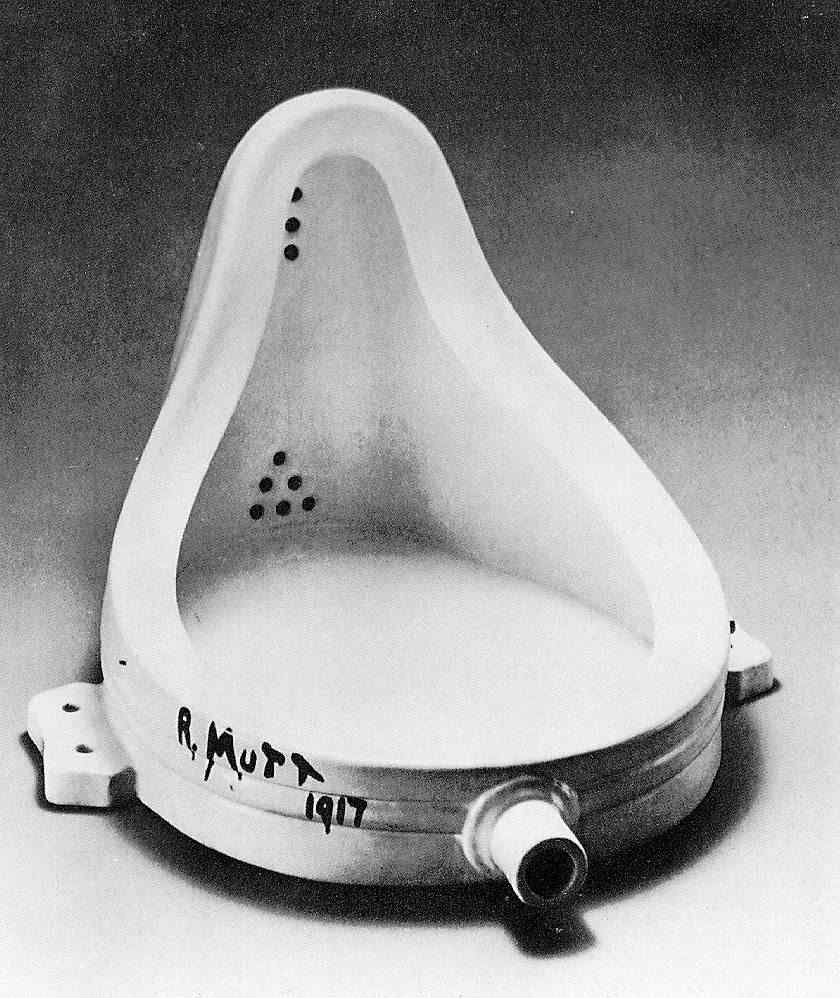
For anyone who cannot tell, that is a urinal, set on its side and labeled "R. MUTT 1917." Now, dear readers, I know you're probably thinking that it's unfair for me to dislike contemporary art, like a Virgin Mary covered by a condom, yet enjoy Fountain. After all, this required basically no work, other than Duchamp signing the urinal. However, Duchamp did not create Fountain with some sort of hidden meaning or social commentary. It was meant to be art against art - if anything it was a critique of the people who would take something like this and dream up some kind of meaning for it, as well as a move to deflate the ego of artists who considered themselves brilliant just for being artists. Duchamp was barred from exhibiting Fountain at the Society of Independent Artists show, even though he was a board member, and the only requirement to exhibit a piece was to pay the entry fee. He resigned in protest, and attended the show with Fountain tucked under his arm, eagerly showing it to anyone who was curious. Fountain was designed to piss people off (pun intended). It was never intended to be celebrated for any sort of aesthetic beauty or artistic genius, and Duchamp would likely be horrified to know that replicas of Fountain can be found in world-class modern art museums and auction houses, where they sell for as high as $1.7 million apiece.
Fountain probably got the reaction Duchamp was hoping for in my AP Art History class. Mr. Aliazzi reveled in our initial disgust with it, followed by various attempts to understand how it could possibly be considered art. I offered that my initial thought as I saw it was, simply, "Piss!", and while the link to the subject matter was pretty obvious, most people agreed that their initial reaction was similar. Had Duchamp earned his college degree with Fountain, I would have been upset.
Upon retrospection, how can I like something like Fountain yet have such disdain for a condom-covered Virgin Mary or a dirt-covered Barbie doll as art? I would say there are two possibilities.
One, I like Fountain because the point is that it isn't supposed to be art; it's a satire of anyone who would present something like it and say it is art, especially if they explain it with some sort of "social commentary" story. A lot of modern art either tries too hard to have a meaning or simply fails at conveying the message. In my case, I think some modern art chooses shock value over maturity or sophistication - for example, the condom-covered Virgin Mary seems less like a thoughtful critique and more like a sophomoric rebellion.
Or, two, which comes from Mr. Aliazzi's definition of art: "Art is human spirit in sensate guise." My fellow AP Art History students and I sensed Partita in B Minor a certain way based on our perspectives and experiences, while someone else might have heard it at their grandmother's funeral and always associate it with a profound sense of loss. Likewise, the human spirit in visual art can be sensed, or better yet perceived, in different ways. I found a dirt-covered Barbie doll mundane and artistically worthless (to use brutally honest terms), while others may have lent it much more merit.
Readers, if we choose to go with my second possibility, which I find I like better, I guess we can't really objectively judge most art as good or bad. I choose to look at art like a well-crafted speech - I generally value nuance and fluidity, and if it chooses to make a bold statement I want that statement to at least appear original and thoughtful. Others choose to look at art like a protest shout - the message is the most important part, and sometimes it needs to be rough, even offensive.
In the end though, this is why I avoid critiquing new art without the disclaimer that it is my personal opinion or some sort of academic support, and why I avoid taking art classes - art is too subjective to be given a letter or number. It is expression, whether bold or introspective, and it is human spirit, whether that spirit attracts you or repels you.
Or, to modify an infamous saying from my uncle, you could judge "bad" art this way - "I look at it and my brain says, 'yuck.'"
Cheers!

No comments:
Post a Comment