Wednesday, December 4, 2013

Civil Debate's Last Gasp

Hello Readers,

I considered writing a post about the big issue facing my college right now - divestment - or any number of smaller debates across campus, but then I realized they were all symptomatic of a larger issue that is even more pressing. That issue is the breakdown of civil debate. It's something that has been happening more and more - I admit to some of the offenses below myself - but needs to be stopped if we want to see anything positive happen with discussion both at college and beyond.

I won't belittle you by talking about how a debate is "supposed to work," because we all understand the general concept - each side presents their viewpoint and the evidence behind it, and the audience or whoever may be participating weighs each side. Rarely is any viewpoint excluded outright, unless it lacks evidence entirely or is clearly bigoted (an argument espousing a return to slavery, for example, would not and should not go anywhere). Perhaps the sides do not agree, but everyone gets their say, and above all, everyone avoids logical fallacies as best as they can and nobody feels like their point was mocked or belittled.

[Important note: I have not argued, am not arguing, and will not argue that racism, sexism, classism, etc. do not exist or have ceased to exist. However, when someone uses these terms to describe a viewpoint opposite theirs merely because they disagree with it, it hurts everyone.]

The divestment debate provides a foil for what has actually been happening lately, though it certainly is not the first time civil debate has been shunted aside. Let me discuss what I saw at the divestment forum on Monday night. It was less of a structured debate and more of an open forum, which can still work, but it quickly broke down into a series of ad hominem attacks and condescending statements toward the other side. For example, I and another student suggested we know the tangible benefits of divestment, particularly the environmental ones, but we were curious about the costs. As I said, it seems like we ought to present a realistic argument to the people in charge of the college's investment fund as to why we should divest our stocks in fossil fuels, and it seemed to me like that argument had not yet been made. In response, rather than someone presenting that argument, I was treated to a belittling and patronizing speech about how we have "values" that go beyond our interests, with the example that "I could steal a backpack because it is in my interest, but I do not because I have integrity." Not only was my question not answered, I was treated as an idiot or someone completely without values for asking it. I have seen similar situations in other debates - earlier today, someone responded to a "why" by simply reiterating that they supported divestment and felt justified in comparing fossil fuels to apartheid without actually explaining why, and then refusing to answer outright. Questions are essential to furthering our understanding in debate - belittling the asker or sidestepping their question helps no one. After I left, I hear it got even worse - as one side explained their viewpoint, the other side snickered and hissed, and one girl let out an audible snort at a comment at one point. It is next to impossible to feel safe or valued in a community where you are openly mocked for expressing your opinion.

Likewise, we trade evidence for logical fallacies. One of the most common fallacies lately has been the ad hominem attack. For example, in last year's Chik-fil-a/gay rights debate, when supporters of excluding Chik-fil-a from on campus events were questioned about their viewpoint, they simply replied that anyone who disagreed with them disrespected the LGBT community. This doesn't answer the question. Furthermore, whenever you call your opposition bigoted, you're equating them with the same people who supported slavery and segregation, and in most cases, this equation is uncalled for. In all cases, it stops the debate, because the "bigots" know they have no fair chance of explaining their viewpoint on those grounds.

Ad hominem also commonly mixes with the "no true scotsman" fallacy, in which someone argues, for example, that someone cannot possibly be an open-minded person and oppose the by-law change I discussed last spring. On the other side of the divestment debate, those against divestment accused those for it of wanting the college as we know it to crumble - without fossil fuel investments, we would not be able to pay for people, facilities, scholarships, and services that make this place what it is (some of those services were later revealed to be paid for by another fund besides investment, highlighting the importance of evidence). This fallacy is close to the "bandwagon" fallacy - a lot of people feel this way, therefore they are right. We make this fallacy a lot with petitions - 33% of the student body signed a petition, therefore this is how everyone feels, ignoring that the signatories are not a random sample nor are they anything close to a majority.

Fallacies aside, the problem at my college is that we cannot have a civil debate because we actively (verbally) assault those with different opinions. If you disagree with someone, they will, rather than asking why you feel that way, explain their viewpoint as if you are a child unable to comprehend some absolute truth. If you consider yourself a Republican and admit to it in class, chances are others in the class will grumble and hiss. If you consider yourself a Democrat and admit to it at frat parties and other social events, chances are someone will ridicule you. Arguments against gay marriage or any gender issue are immediately dismissed as intolerant, regardless of any evidence or reasoning behind them. When someone presents a viewpoint different from the majority belief, we do not give them the chance to explain: the viewpoint is "ludicrous" or "blatantly offensive", and the person expressing it is "ignorant," "bigoted", or simply "wrong."

The irony of all this is that by ignorant and mocking these viewpoints in the name of being diverse, tolerant, progressive, conscientious, or whatever the word of the day may be, we are actually being intolerant and close-minded. Granted, nobody here physically attacks someone for having a different opinion, but I have met people from all parts of the political and ideological spectrum who feel uncomfortable expressing their viewpoint because they will be "shunned," "made into a pariah," or "assaulted"(again, verbally, which can be just as bad as physically). If we really want to consider ourselves a safe and open-minded community, the degradation of debate has to stop.

One of my least favorite debate missteps is when someone rails against a problem without proposing a viable solution - that is, prohibiting option A but providing no option B, so I would like to offer a way beyond the current status quo. First off, we need - on all sides - to respect the idea of civil debate. Let all sides express their opinion, backed with evidence rather than ad hominem attacks and emotional appeals, and listen to their opinions no matter how much we might disagree with them. Second, we need to work against those who continue to belittle and insult their opponents - their claim is not wrong because they do so, but they harm the debate and should not be allowed to continue to do so. Third, these sorts of rules would be best fostered in a clear debating environment. Passing campus-wide "debating laws" is impractical, but if we set up a debating society or forum where we could have open discussions with some guidelines (present evidence, do not disrespect someone for disagreeing), those who participate would get more out of those discussions, and spread that to their debates and discussions beyond the society or forum. Finally, as an overarching shift, we need to recognize that while the current state of affairs benefits us - after all, it can be easier to sidestep someone who disagrees than to address his or her criticism and questions - it hurts all of us overall by making us stubborn, intolerant, and close-minded.

Currently, we have "forums" and (primarily online) discussions where the conversation quickly degenerates into belittling, condescending, and insulting comments on all sides, rather than a productive debate that promotes the free and open exchange of ideas. If we revitalize civil debate and truly tolerate a broad spectrum of viewpoints, everyone will benefit as a result. I will do my best to restore civil debate in my life, and I hope you will do the same, even if you disagree with some of the points I've made here.

Cheers!

EDIT: Here's a fun site I visit from time to time on debate, plus a graphic I've had kicking around my computer for a while now:

www.yourlogicalfallacyis.com


Tuesday, October 1, 2013

The Shutdown Breakdown

Hello Readers,

After weeks of failed deals, measures that would never work, and attempts to pass them anyway, the US Congress failed to pass a bill that would allow the United States to keep spending money. As everyone probably already knows, people, we're in shutdown.

Or, more accurately, we're in partial shutdown. What exactly does that mean? Basically, the government can no longer do anything with discretionary spending. The "credit card" is maxed out, and we did not vote to raise our limit. This article from the BBC does a good job of explaining who is affected, but I'll break it down even further.

- About 80% of government employees will still go to work today. These include people who are not paid by discretionary spending (such as postal workers), people who will not be paid but still have to carry out government tasks that are not paid for by discretionary spending (like social security workers), and people who will not be paid but are considered essential "to cases of threat to human life or property where the threat can be reasonably said to the near at hand and demanding of immediate response (such as TSA officers, FEMA workers, and the FBI). The "essential" staff will generally not receive paychecks until the shutdown is over, but President Obama signed a bill last night to ensure that active-duty military will still be paid.

- Members of Congress (both the House and Senate) will still be paid, although their staff will not be, as they are considered "non-essential."


- All of the Smithsonian museums (including the National Zoo) and National Parks (including Yosemite, which turns 123 years old today) are closed until further notice. Staff essential to these attractions, like zookeepers and emergency services, will remain on duty. Those staying in National Parks will be asked to leave as soon as possible. The Smithsonian cannot legally allow their employees to keep working, even as volunteers.


- National monuments are also closed. The National Park Service is actively barricading the Lincoln Memorial and World War II Memorial, among others (reports suggest that WWII vets have knocked down the barricade outside the memorial to get inside). The NPS security is still on staff to monitor these monuments.


- Over half of the workers at the Department of Education and Department of Health and Human Services have been sent home.


- The Environmental Protection Agency has effectively closed. There is still a skeleton crew on hand if a major environmental disaster happens.

- The United States is not free-falling into anarchy. Your local government is still largely functioning, and the police are still there to arrest you if you decide now is the time to start a crime spree.

Those are the facts, now for the analysis. Like the sequester before it, the government shutdown hurts the average American more than anyone else. While I am glad that we can still keep those protecting our nuclear stockpile employed, that satisfaction is severely marred by knowing that the Department of Education cannot continue their work on Race to the Top, a grant competition designed to help struggling schools; that millions of schoolchildren and families who had hoped to visit the Smithsonian museums in the coming weeks now must make alternative plans; and that anyone who had hoped to learn more about our space program at www.nasa.gov will find that they cannot even access the homepage. During the sequester, all tours to the White House, even informal ones, were cancelled; the same is now true for the Capitol and Supreme Court as well. If you think about that, it means that in a government by the people, of the people, and for the people, most of the people cannot set foot inside the rooms where our country's future is being decided.

And then there's Congress. Congress, who stayed up past midnight last night trying to pass a bill to avert a shutdown. Congress, who failed to pass such a bill, and yet faces no real repercussions. Congress, who has led the nation right into this mess. As most of you likely know, the core conflict was this: Americans needed the government to stay open, but the Republicans badly wanted to defund, delay, or destroy the Affordable Care Act (also known as the ACA or Obamacare), and the Democrats badly wanted to ensure that the ACA remained as-is. So, the Republican-majority House of Representatives would pass a budget bill that included language on the ACA, the Democrat-majority Senate would reject it, up until midnight last night, when party politics superseded the needs and wants of the American public. The result was that the Congressmen and Congresswomen responsible at this mess will continue to be paid to point fingers at each other, while the people they claim to represent get screwed (see above). 

I don't blame the Republicans or Democrats - I blame all of them, collectively. Most other Americans, do, too - though there are no new opinion polls since the shutdown began, the polls from yesterday show Congress's approval rating sitting at a new all-time low of 10%, while disapproval is at 87%. I would say that the Republican Congresspeople are slightly more to blame, in that they could have just passed a bill without anti-Obamacare language and saved the fight for a better time, but both parties had the option to collectively realize that keeping the government funded ought to be more important then their political agenda and pass the budget bill, regardless of what it did to the Affordable Care Act.

A bill has come to Congress numerous times suggesting that they should not be paid in the event of a shutdown, but, predictably, it has been set aside in limbo, because who would realistically vote on conditions that take away their paycheck? So, while I am unsure how such a measure would be passed, I wanted to suggest a few options I have heard for getting Congress to get their act together, stop the bickering and brinksmanship, and represent their citizens, not their party:

1. Fire the lot of them. I like this idea in principle, but it creates bigger problems. If we immediately fire everyone in Congress, we'd have to take the time to elect a whole new Senate and House of Representatives, when what we really need to do is end the shutdown as soon as possible.

2. Ensure that everyone in Congress cannot run for re-election in the next cycle, or if they do, ensure that they do not get another term. Again, I like this one in principle, but not in practice. If Congresspeople do not have to worry about re-election, what duty will they feel to their citizens? They could easily pursue their personal or political agenda without fear of losing public support. Also, public opinion polls suggest that while most people disapprove of Congress as a whole, most people support their own Representative or Senator. During the next election cycle, few voters are likely to blame their Representatives in government for the shutdown. 

So, we can't exactly hit Congress at their jobs. The better option is to go after their money. These measures would require some sort of government approval - good luck with that - but they would be more effective in practice.

3. Congress doesn't get paid until the shutdown, just like hundreds of thousands of other federal workers. 

4. For every day that the shutdown continues, Congress takes a 10% pay cut per day, OR they go one month without pay (7 day shutdown = 7 months where Representatives and Senators do not get paid).

Some will argue that these financial members are unfair, and that we'd be legislating Congress into the poorhouse, but let's be serious. They are not, like many Americans, living paycheck to paycheck. They just ensured that hundreds of thousands of Americans will go without pay for the foreseeable future, with no consequence to themselves. Furthermore, when anyone else in this country fails to do their job, they get fired or at the very least receive a pay cut. If these are supposedly our leaders, why do they not lead by example, instead of acting like detached nobility? Something must be done to end this shutdown as soon as possible, and to ensure Congress cannot allow this to happen again. We have now seen two shutdowns and a sequester in 17 years, and all three of these events were supposed to be so terrible that they could never happen. We're showing the current generations that America, arguably the #1 superpower in the world, is fatally flawed and dysfunctional.

However, there is the smallest of silver linings to put this in perspective. When most countries have a shutdown like this, it is a sign of an even bigger disaster, such as total financial collapse, civil war (though Bashar Al-Assad of Syria still manages to pay his people), or revolution. There has been no military coup, we are not in the midst of a financial crisis to put the Great Depression to shame, and people are not fighting or rioting in the streets. The Earth did not stop spinning. That's not much to be grateful for right now, but it is something.

My usual sign-off seems inappropriate right now. Good luck, fellow Americans.

Monday, July 15, 2013

Monet's Art Final, Part 3: Poetry, Fountain, and Conclusion

Hey readers,

This is the final part of my essay on art.

I arrived at college with the lessons I had learned in high school as well as the experiences from art class as a boy, well aware that I understood art from a historical perspective but I was in no way an artsy type of person. My only foray into the college artistic community was when I joined the slam poetry team, pretty much as a way of working on my creative writing. I was not an obvious candidate from the start - I write much more prose than poetry, and the subject material of the average slam poem - discrimination, violence, poverty - is pretty far off from anything I write. Surprisingly, I was asked to join not only the group but the performance team. While my humorous retrospectives on relationships and being a nerd were not standard slam poetry fare, people seemed to like them. To make a long story short, however, I left the group part of the way into my sophomore year. I was annoyed that I could spend two weeks refining a poem on political violence in Zimbabwe only to have it mercilessly shot down, and then scribble down some thoughts I had on relationship drama at 1 AM and have it be a smash hit. I imagine this is what teen idols feel like when their first role in a serious drama gets panned.

At the same time, through the poetry group, I met a number of the artsier people at college, which contributed to my disillusionment with modern art and poetry as artistic mediums. In AP Art History, there was a sort of unspoken truth: there are the great artists, whose works end up in hulking textbooks about art and are displayed in world-famous museums, and then there are the other people, who try their hand at art, but are ultimately unsuccessful for a variety of reasons. Perhaps they are a painter who makes nice but not terribly original landscapes that they'll sell in an art gallery in Hawaii. Or, like the student in the first part of this essay, they are someone who puts a condom on the Virgin Mary and explains how it's this commentary on the Immaculate Conception and other religious/social stuff. I met more of the latter category in college and found myself inexplicably irked by them.  I overheard one poet talking about her latest project for sculpture class; I do not remember the exact details, but I do remember her saying something like, "I found a Barbie doll the other day half-buried in the dirt, so I dug it up, and now I'm adding it to my sculpture." My not-terribly-sophisticated response was to inwardly wonder how she could be earning the same degree I was (albeit with a different major), since I couldn't fathom how a half-buried Barbie doll was in any way related to a 15-page paper on Ukrainian foreign policy. Looking back, I could argue that neither is supposed to related to a larger audience, but at the time, my main objection to it was that it seemed to lack any sort of intellectual thought. Then again, maybe the artwork had some sort of meaning I failed to comprehend.

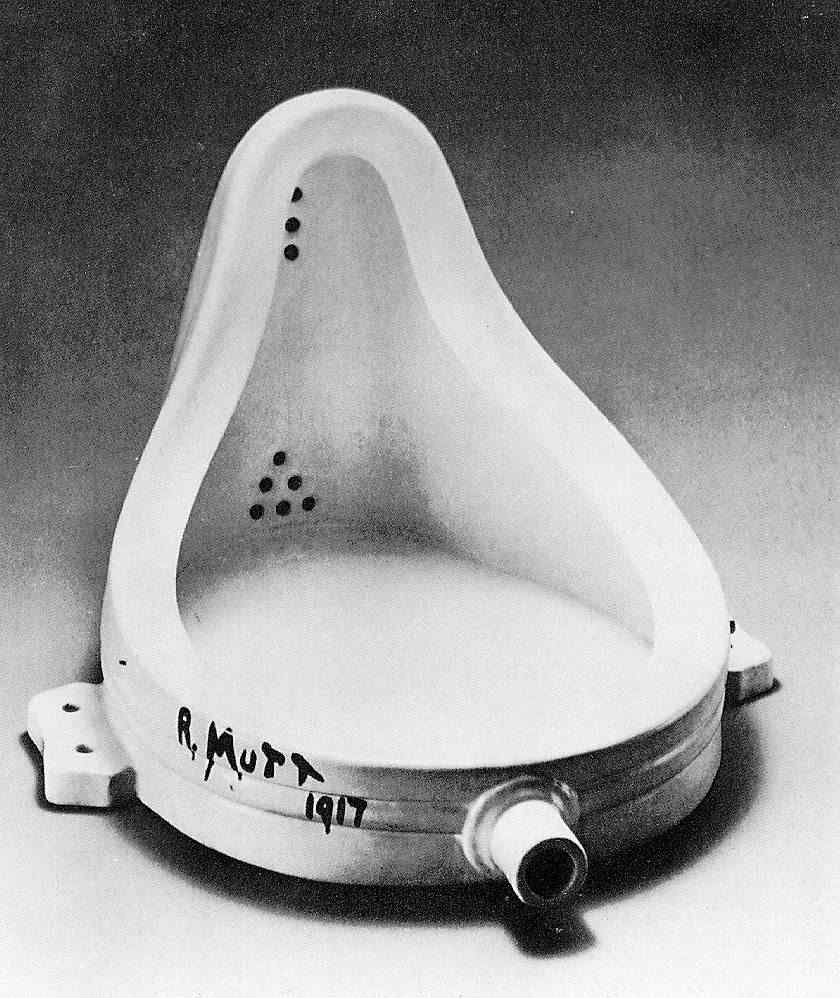
Neither this frustration nor any of my experience explains why I like Marcel Duchamp's Fountain. For those who aren't familiar with this iconic Dadaist work, here is a picture:


For anyone who cannot tell, that is a urinal, set on its side and labeled "R. MUTT 1917." Now, dear readers, I know you're probably thinking that it's unfair for me to dislike contemporary art, like a Virgin Mary covered by a condom, yet enjoy Fountain. After all, this required basically no work, other than Duchamp signing the urinal. However, Duchamp did not create Fountain with some sort of hidden meaning or social commentary. It was meant to be art against art - if anything it was a critique of the people who would take something like this and dream up some kind of meaning for it, as well as a move to deflate the ego of artists who considered themselves brilliant just for being artists. Duchamp was barred from exhibiting Fountain at the Society of Independent Artists show, even though he was a board member, and the only requirement to exhibit a piece was to pay the entry fee. He resigned in protest, and attended the show with Fountain tucked under his arm, eagerly showing it to anyone who was curious. Fountain was designed to piss people off (pun intended). It was never intended to be celebrated for any sort of aesthetic beauty or artistic genius, and Duchamp would likely be horrified to know that replicas of Fountain can be found in world-class modern art museums and auction houses, where they sell for as high as $1.7 million apiece. 

Fountain probably got the reaction Duchamp was hoping for in my AP Art History class. Mr. Aliazzi reveled in our initial disgust with it, followed by various attempts to understand how it could possibly be considered art. I offered that my initial thought as I saw it was, simply, "Piss!", and while the link to the subject matter was pretty obvious,  most people agreed that their initial reaction was similar. Had Duchamp earned his college degree with Fountain, I would have been upset. 

Upon retrospection, how can I like something like Fountain yet have such disdain for a condom-covered Virgin Mary or a dirt-covered Barbie doll as art? I would say there are two possibilities. 

One, I like Fountain because the point is that it isn't supposed to be art; it's a satire of anyone who would present something like it and say it is art, especially if they explain it with some sort of "social commentary" story. A lot of modern art either tries too hard to have a meaning or simply fails at conveying the message. In my case, I think some modern art chooses shock value over maturity or sophistication - for example, the condom-covered Virgin Mary seems less like a thoughtful critique and more like a sophomoric rebellion. 

Or, two, which comes from Mr. Aliazzi's definition of art: "Art is human spirit in sensate guise." My fellow AP Art History students and I sensed Partita in B Minor a certain way based on our perspectives and experiences, while someone else might have heard it at their grandmother's funeral and always associate it with a profound sense of loss. Likewise, the human spirit in visual art can be sensed, or better yet perceived, in different ways. I found a dirt-covered Barbie doll mundane and artistically worthless (to use brutally honest terms), while others may have lent it much more merit. 

Readers, if we choose to go with my second possibility, which I find I like better, I guess we can't really objectively judge most art as good or bad. I choose to look at art like a well-crafted speech - I generally value nuance and fluidity, and if it chooses to make a bold statement I want that statement to at least appear original and thoughtful. Others choose to look at art like a protest shout - the message is the most important part, and sometimes it needs to be rough, even offensive. 

In the end though, this is why I avoid critiquing new art without the disclaimer that it is my personal opinion or some sort of academic support, and why I avoid taking art classes - art is too subjective to be given a letter or number. It is expression, whether bold or introspective, and it is human spirit, whether that spirit attracts you or repels you.

Or, to modify an infamous saying from my uncle, you could judge "bad" art this way - "I look at it and my brain says, 'yuck.'"

Cheers!

Monet's Art Final, Part 2: Color, Art History, and Bach

Hey readers,

This is part two of my story on art. The first part can be found here (or just look for the previous entry on my blog). Let's pick up where I left off, at the start of high school:

In my freshman year of high school, we were given three options - join glee club, join orchestra or band, or take a year long art course that featured a quarter each of drama, visual art, and music theory, followed by a quarter where we did a 3-week final project in each. Since my singing voice is so bad I don't even like to sing in church, and I have no skill in musical instruments whatsoever (long story, not worth it), I opted for the drama/art/music choice. I also figured that since anyone was able to take it, we would be judged on the amount of work we put into our art, not the quality of the final product. Our first assignment was to draw a picture that incorporated our name by spelling it out in some form. I labored over a perspective drawing of my name in a game of Scrabble. At my teacher's suggestion, I kept it black and white, focusing instead on tone and shadow. Just to make sure, because everyone else was using color, I asked him again. Black and white was the way to go, he assured me. I got a B on the project, with comments along the lines of: "Should have used color to make it more vivid." At that point, I decided art clearly wasn't my thing. After a year of drama class (another long story not worth going into), I dropped out of the arts entirely, focusing instead on creative writing and speech and debate.

At the end of junior year, I decided on a whim to support a small movement amongst my classmates to reinstate AP Art History as a class. I don't know why I did, given my past experiences with art and my fear of memorizing lots of details about artworks, but it seemed worthwhile. Besides, AP Art History was my third choice for social studies, after AP Psychology and AP Government. As luck would have it, my schedule did not allow for either of those two, and I was placed in AP Art History along with nine other seniors who had actively lobbied for the class and put it as their first choice. My mind flashed back to freshman year - I had Western Civilization I with the (in)famous Mr. Aliazzi, the toughest teacher at the school, right after he had finished teaching AP Art History to the seniors. I remember haggard students staggering out of class, clutching their Art History tomes and telling us, grimly, "Don't take AP Art History with Aliazzi unless you really want your butt kicked." This was not college, and I could not run to the school's scheduler in a panic to demand to switch into something else, so I resolved to make the best of it and soldier through the year.

Although a few of my classmates and I would come to refer to the decision to take both AP Biology and AP Art History as the "suicide combo," AP Art History turned out to be one of the best classes I took in high school if not throughout my entire education. Mr. Aliazzi, who had been kind of intimidating our freshman year, was knowledgeable and witty, if still a little blunt (a hallmark of his teaching style). He made sure we knew that we had convinced him to teach art history, instead of him convincing us to learn it, so we were going to take an active role in our learning. If a student zoned out, he would bark, "Why are you staring at me like a cow staring at a gate!?" He would commend us for our efforts to analyze everything from Greek contrapposto to Flemish still-lifes to French Gothic cathedrals, yet always challenge us to dig deeper, say more with less, and write compelling papers rather than bland ones that simply met the criteria. To this day, I remember how he would assign paper lengths:

Student: "Mr. Aliazzi, how long should this paper be?"
Aliazzi: *Pause* "Don't bore me!!"

Sure enough, that was his standard. We were to take as many words or pages as we needed to compare Early Kingdom and Late Kingdom Egyptian sculpture or North and South Renaissance tryptychs, but he always told us politely but firmly if we had blathered on. He treated us like men less than a year away from college rather than boys who knew nothing (his comments about his freshmen were always a hilarious start to the day - in one case, a freshman asked him if early medieval peasants celebrated Thanksgiving). He did not suffer fools well, but as a result, I learned more than I ever expected about art, and it really sunk in. I was floored when I scored a 5 on the AP Art History test, not just because it meant I would not have to take an art class in college, but also because it meant I actually knew enough about art to write clearly and insightfully about it.

As luck would have it, AP Art History was the final class I had on my last day of senior year. Most of my teachers had simply cancelled class so we could play outside (second semester seniors are like kindergarteners in that way), and my AP English - Satire teacher had sprung a surprise final quiz on Catch-22 on my class, but not one person in my AP Art History class expected Mr. Aliazzi to cancel class - we did not even dare ask him. With the AP Art History Exam less than two weeks away, he let us ask any questions we had, and then asked us, now that we had studied art for a school year, what we thought art was. We offered our opinions, all of which were met with varying degrees of support and criticism, then he paused.

"I'm going to try and offer what I think is a fairly good definition. Art is human spirit in sensate guise."

The room fell silent. We were unsure of what to say. For my own part, I thought that was about as close to a perfect definition as we were going to get.

Mr. Aliazzi continued, "Let me show you. Follow me." He led us to the choir practice room, and took a seat at the grand piano at the front. We had all heard of Mr. Aliazzi's piano skills - there was even a rumor that he had once played keyboard for the Grateful Dead - but we also knew he was remarkably shy about it; he only played before school in a locked room, and never took requests, no matter how much his students pleaded. "This is Bach's Praeludium to Partita Number One in B Flat," he said, and began to play. For the next two minutes, we all watched, mesmerized, as he played as beautifully as any professional pianist.

This is the piece, but it does not fully capture the experience.

It was not just the music itself, but the environment he had put us in. We were experiencing his playing under a number of emotions: first, that he was playing piano for us of his own choice; second, that we were listening to it with the words "Art is human spirit in sensate guise" still at the front of our minds; and third, that these two minutes were the final two minutes of AP Art History, senior year, and of high school. He finished the piece, then quietly said three words: "And so, goodbye." He didn't need to say anything. We understood that Bach's Partita Number One in B Flat was his goodbye to us. We left in silence, not really sure how to react but aware that we had just been a part of something truly special.

I graduated high school aware that I had little to no artistic talent but with a greater sense of what art was and had been from the Lasceaux cave paintings to the present day, as well as the lasting memory of Mr. Aliazzi's piano playing and his final lesson to us: explicitly, art is human spirit in sensate guise, and implicitly, art that fulfills this definition does not have to be purely visual - it need only be sensed.

I was off to college, safe in knowing that I would not have to earn a grade by drawing, painting, or sculpting. Part three will finish my experiences with art and allow me to offer some brief thoughts on it. Cheers!

Sunday, July 14, 2013

Monet's Art Final, Part One: Pottery, Kobe, and Spears

Hey Readers,

I just bought a book by one of my favorite bloggers, Adam Ellis (you can read his stuff, which is always interesting and almost always hilarious at www.booksofadam.com), and I've read his first story, about why he decided to leave art school. In short, he was surprised and more than a little annoyed that one of his classmates submitted as her final project a dollar-store Virgin Mary statuette sheathed in a latex condom. "'I put a condom on the Virgin Mary,' she said flatly." He was even more surprised an annoyed when his professor and fellow students started gushing over how "brilliant", "defiant", and "brave" the piece was. By contrast, when he attempted to display his art nouveau style portraits of Captain Planet, a 90s cartoon action hero, and relate them, somewhat halfheartedly, as a commentary on the commercialization of cartoon characters, the professor suggested they weren't relevant "in the grand scheme of things." While I laughed at the story (and accompanying drawings from Ellis himself), it made me think about my own experiences with art, especially modern art, and my general disdain for works like Latex Virgin Mary.

My experiences with art have been mixed at best. As I was thinking about this piece, I realized I don't have a standard set of criteria for what makes good art, or even what makes art, as should become obvious through this post. As a little boy, I wanted to be an Astronaut Artist President, which I guess was fairly common amongst my classmates, but as I got older, my astronautical, artistic, and presidential  skills kind of waned.

At my elementary school, we didn't take formal art classes until first grade. My art teacher was a really cool guy named Mr. Starinsky, who we called Mr. Star. He was a big believer in expressing creativity - our art tables were wildly uneven from paint splatters, dropped bits of clay, and other art supply castoff, but Mr. Star just used the tables to teach us about texture. By the end of first grade, he was teaching us how to draw silhouettes of city skylines, and how to build a portfolio. We actually had physical portfolios in the art storage room, which we were encouraged to decorate. He told us that in fourth grade, we'd get to paint the stools and trashcans in the art room. In short, art was a lot of fun in first and in second grade.

After second grade, Mr. Star left to become something assistant curator at the Cleveland Museum of Art, meaning we got a new art teacher - Mrs. Cypress. She was basically the opposite of Mr. Star. Art projects were to be done by her rules only - suddenly, pottery (my favorite part of second grade art) was about proper technique of making coil pots and less about experimenting with glaze colors. My drawing of an incredibly long Chinese dragon was not well-received (mostly because I ran out of time to color the whole thing in). Within a year, the textured tables were replaced with new, spotless ones that we had to keep clean, much to her delight and my dismay. My love of creativity in art class, was, in a word, extinguished.

In eighth grade, I got my first taste of creating modern art. We had a student teacher in our art class who gave us each two sheets of corrugated cardboard and told us to create a sculpture with it. We would have to present what the "meaning" of the artwork was, as it had to have some kind of personal connection. I remember three artworks in particular. One student carefully made a cardboard cutout of Kobe Bryant, and was at a loss for words when he had to explain it:

Teacher: "So, tell us about your work."
Kobe Kid: "Well...it's Kobe."
Teacher: "Okay...so, do you see yourself as Kobe? Is Kobe a special influence on you or something?"
Kobe Kid: "I dunno, I just really like Kobe."
Teacher: *Silence*

While most of the sculptures were put on display around school, one student's was kept in the art room because it showed someone holding a gun to his head. I don't remember what the work was about, but I do remember the speech we got about how a middle school is different than an art museum. The student would be getting an A (he went on to art school after graduation), but we couldn't display it for its subject matter. I think this was my first experience with what I would consider tasteful controversial art. It seemed different to me than some of the more objectionable stuff at the Cleveland Museum of Contemporary Art, like a picture of Spiderman smoking a joint or a picture of Christ splashed with urine. Actually, that provokes some further thought, which I would sum up as "Just because you can do something, that doesn't mean you should," or "just because it's edgy doesn't mean it's worthwhile." Consider the much talked about Pussy Riot case in Russia from last year - most Russians believed the women should be jailed, not because they didn't have a right to free speech (they did) but because their performance was seen as blasphemous and disrespectful.

The third artwork I remember is my own, and it was my first attempt at modern art. I was quite proud of it - in response to a lot of bullying in middle school, I cut out a large, head-shaped piece of cardboard, painted it green, and then rammed red cardboard spears through it. As I explained it, my point was that people who stand out and try to be different are treated like spears going through someone's head - they stick out and are seen as bad. Admittedly, it was a somewhat immature work based on a rebellious sentiment, but I was proud of it at the time. I appreciated the encouragement from my art teacher to make the spears look as gory as possible - not so much red as bloody. I remember one teacher who I didn't particularly like confronted me after it went on display to tell me that she found it offensive, but once I realized she couldn't really punish me for it (it was not explicit - there was no profanity, nudity, or excessive amounts of violence, nor anything exceptionally controversial addressed in it, like abortion or suicide), I basically thanked her for her criticism (with the minimum amount of sincerity needed to avoid some sort of punishment for disrespecting a teacher) and moved on.

As I entered high school, I had a weird understanding of art. I liked looking at all kinds of art, from classical Greek sculpture to Picasso, but I liked Modern Art especially. However, within modern art, I lacked that clear set of standards to say what I liked and what I didn't. I loved Roy Lichtenstein's pop art style, but Andy Warhol's soup cans didn't really do anything for me. I could stare at a perpetual motion machine for hours, but a looping video of a forest scene only confused me. Through AP Art History, as well as my limited artistic encounters in college, I would develop a more nuanced understanding of art, albeit one that wasn't any clearer.

Readers, I'll keep going in Part Two, which I hope should be uploaded in a day or two. Like a solid artwork, the big picture will make sense even if these details do not just yet. Cheers!

Saturday, July 13, 2013

Reasonable Doubts

Hi Readers,

I'm writing this about 40 minutes after a Florida court has handed down its verdict on the George Zimmerman case. I am hardly a legal authority, but I enjoy following controversial cases like this, so I wanted to offer my thoughts on the case and the ultimate decision to find George Zimmerman not guilty of murder or manslaughter.

As some background, when the Trayvon Martin shooting first came to light, I signed at least one of the petitions to arrest George Zimmerman and try him for Martin's murder. At that time, I understood the facts of the case in the way that many people aware of that fateful night did. As the case was being reported, George Zimmerman, a neighborhood watchman of sorts, had basically stalked and killed Trayvon Martin as he walked home from the local drugstore, all because Trayvon "looked suspicious." If this account is truly what happened, then clearly George Zimmerman should have been found guilty of murder. Trayvon was only "armed" with an iced tea and a bag of Skittles, and nobody - regardless of race, religion, gender, etc. - should be attacked or killed because they "look suspicious."

I was so incredulous that this sort of thing could happen in 21st century America that I decided to follow the trial, in part because I was curious to see how Zimmerman's defense team could possibly argue that he was not guilty.

At this point, it's worth reminding everyone about an essential tenet of America's criminal justice system - the phrase "guilty beyond a reasonable doubt." Obviously, the criminal justice system in America is far from perfect, and people have been put in prison even when there was a reasonable doubt to their guilt, but in each case, we should try to apply this standard, and to remember that justice is (or should be) blind.

As I watched the trial, I learned more about the facts of the case. Martin wasn't gunned down just for walking home wearing a hooded sweatshirt, which Zimmerman thought was suspicious. Rather, Martin and Zimmerman had fought. This is where a lot of the doubts emerge. The facts suggested that Martin may have had the upper hand, at which point Zimmerman reached for his gun and pulled the trigger. In other words, Zimmerman believed he was in danger - according to the defense's witnesses, Martin was slamming his head into the sidewalk, and fired in self-defense. Zimmerman may have started the physical fight, or Martin may have - either way, the two physically fought.

I'm not falling for the defense's case hook, line, and sinker. I did not find their version of that night's events significantly more credible than the prosecution's argument. However, I did not find their version significantly less credible, either. In the end, I was left with two conflicting stories. In one, George Zimmerman was a "wannabe cop", a vigilante who fought with, and then murdered Trayvon Martin because he prejudged him to be a violent criminal. In another, George Zimmerman was a concerned citizen, who was maybe a little misguided but ultimately trying to do the right thing, who fought with Trayvon Martin, cried out for help when he thought (whether or not this was truly the case) that Martin was going to seriously injure him or worse, and in a final moment of panic drew his firearm and shot Martin.

In neither argument was race or the "Stand Your Ground" law a major or even a minor factor. Brief mention was made about Martin's hooide and snacks, but that was not a central point either. Both the prosecution and the defense stuck to the events themselves.

It doesn't matter which story I believe more, or if I find the two equally credible. In my mind, which I believe was the way the jury felt too, I could not find a reasonable way to totally exclude the defense's story. And, as defined by our criminal justice system, if the jury has reasonable doubts to someone's guilt, they must declare that person not guilty. Maybe George Zimmerman did murder Trayvon Martin, but I still have my doubts as to whether or not that's true. Either way, he should not be proud of what he did, and I'm sure that night is going to haunt him for the rest of his life. Note, that he was not declared "innocent" - because he isn't - but he was declared not guilty of murder or of manslaughter. But, according to our legal code, he was not guilty beyond a reasonable doubt, and thus justice was served tonight.

It is worth pointing out - this verdict does not make murder legal. I'll say that again, just because I've seen a lot of people assert the opposite - this verdict does not make murder legal. I know a lot of people are afraid that this is a big step back for race relations in America. However, as I've alluded to before, if someone shoots someone else - regardless of race, gender, religion, etc. - just for looking suspicious, that's still murder, pure and simple. This verdict changes nothing about that. This verdict is more of a legal lesson - when a fight breaks out between two people, and it's unclear if the shooting was in self-defense or out of ill will, the defendant gets the benefit of the doubt. Innocent until proven guilty. The jury did not believe that the prosecution proved George Zimmerman was guilty.

My final wish is that we all can accept this decision, even if we have our personal misgivings about it. I know that our justice system is flawed, and it is also my hope that it can improve to be truly blind and judge everyone's guilt beyond a reasonable doubt.

Tuesday, June 4, 2013

Cities of Europe

Hey readers,

To those who have anxiously awaited a new post, I apologize for not writing a new one sooner. A mix of finishing my semester in Denmark and starting my new internship in DC has left me really busy, and while I've got a number of new posts in the works, from book reviews to my thoughts on religion, I haven't been able to complete anything yet. So, to whet your appetite for the future, here's a short post I thought of on my way home from Denmark.

I visited a number of cities in Europe this past semester, and while I hope to write something about all of them, especially the ones I have not yet written about, I wanted to open with my general impressions, alongside a "title" I thought of for each city as I saw it. Here they are:

Copenhagen: City of Churches. This was not immediately apparent, even to me, until my family came and visited. As my dad and I walked around Copenhagen, he regularly asked me about the church towers and spires we saw, and I had to admit that although I walked past two or three churches every day, I had not thought about how common they were. Copenhagen has some pretty amazing churches, whether it's the "Rundetaarn" - which I believe is the oldest observatory in Europe, or the Church of Our Savior with the golden spiral tower that you can walk to the top of (though I, with a terrible fear of heights, chose not to), Copenhagen is full of diverse and fascinating churches, even though it is not known for them.

Paris: City of Art. I know, Paris is the "City of Lights" and it was evident to me how it got that title while I was there, but I think it is more deserving of my title. Paris is home to numerous museums filled with art from across the centuries, from the enormous Louvre to the modern Pompidou to the eclectic Musee D'Orsay...and these are just the top three. Aside from these museums, which dominated my time there, the city itself is an architectural gem. I was particularly impressed with the art nouveau style evident in nearly all of Paris' main streets, which has adapted to its 21st century tenants almost seamlessly. Although it is not a museum per se, one of my favorite art landmarks was Sainte-Chappelle, a chapel on the Cité Island (I want to call it Ile de Cité, but I'm sure my French is wrong there). The chapel is the crown jewel of the rayonnant style of architecture, with absolutely astounding stained glass windows. On top of these colorful and shining windows, every surface seemed to be covered in either shining gold paint or some vibrant color.

Amsterdam: City of Walking. Out of all the cities I visited, Amsterdam was really unique, as it was the only city where I felt like the major attraction was the city itself. Sure, there were museums and other sights to see, but I found I enjoyed Amsterdam the most when I left my map at the hotel and just wandered along the canals, occasionally stopping for coffee (not at a coffeeshop, Amsterdam's infamous marijuana-dealing establishments, but at an actual cafe) or dinner. There's something beautiful about Amsterdam's streets, whether in the middle of the day or late at night, and the city is compact enough that I was able to easily walk around it without getting tired. Should you find yourself there, I recommend walking around the western canals right around dusk - the combination of the sunset, the streetlights, the buildings, and the canal itself is absolutely wonderful in that it conveys both a sense of exoticness and of homey comfort, like it's something foreign yet you belong there.

Venice: City of Canals. This was an obvious one, but Venice is a city unlike any other because there are no major roads outside of the bridge to the mainland. Every street is a twisting alleyway, and the only way to make sense of the city is to take the canals. Much like Paris, the city is an artwork in itself, but the canals are what make it unlike any other city. I know that both Copenhagen and Amsterdam have canals, supposedly to emulate Venice, but this is like getting a kiddy pool to emulate a tropical island - yes, you have some of the same physical components, but it's not even close to the original, which really cannot be copied.

Sarajevo: City of Conflict. This sounds like a bad thing, and certainly not something the Bosnians want to be remembered for, but Sarajevo remains literally and figuratively scarred by the Balkans conflict of 1992 to 1995. That said, I liked Sarajevo in large part because of the Bosnians' resilience. Everyone we talked to had been hurt by the war in some way, and many were concerned about the present state of the Bosnian political system (most pointed out that the country is currently governed under a peace treaty rather than a formal constitution, which causes all kinds of problems), but they remained generally happy and optimistic. The city itself is incredibly moving - some buildings are pockmarked by artillery fire or half-demolished, but the people there continue to look forward and live their lives focused on ensuring the future remains peaceful, while still mindful that the crimes of the past must have justice and that Bosnia as a whole deserves some kind of resolution to their tragic recent history.

Dublin: City of Liquid and Literature. As a 21-year-old who loves to read, this was quite likely my favorite city. Dublin knows it is home to both the Guinness brewery and the Jameson distillery, and does not hide its obvious connection with the almost-cliched "Irish pub," but I liked this element to it. The Irish pubs displayed all of the best qualities one traditionally associates with an Irish pub - great food, great beer, and friendly, easy-going people. Beyond the "liquid" history, Dublin has a great literary history too, and it is actually a UNESCO literary heritage site to prove the point. I spent hours in bookstores while I was there, and also visited the grave of Jonathan Swift, the Irish satirist (in)famous for "A Modest Proposal". I talk more about Dublin in my earlier post, "Booklust."

Belfast: City of Ships. Belfast is where the Titanic was built, but the city remembers that as a mark of pride, not of tragedy, even with the Titanic memorial just outside of the city hall. Belfast was a town built around its shipyards, which are still booming (the dark fate of the Titanic apparently did nothing to damage the shipbuilders' reputation). Unlike Sarajevo, Belfast has almost entirely moved on from its history of conflict, and is eager to champion its greatest strengths and accomplishments. As someone who loved reading about the Titanic as a kid, I really liked the Titanic museum, which talked not only about the ship itself, but about how building it and its sister ship, the Olympic, was a great achievement for the city as a whole.

London: City of Cities. This is kind of a cheat, as London is known as the "City of Cities," but when I was there I found it to be completely true. London is a city where you can go into the underground (also known as "the Tube"), ride it for ten minutes, come out at a different station, and it will look nothing like the city where you entered. The same is slightly true for Washington, D.C., but London takes it to an extreme. The city encompasses luxury townhouses, towering skyscrapers, old castles and palaces, sprawling green parks, bustling markets, and more. It is the only city I've been to where I've thought I could live there for my entire life and still feel like I haven't seen it all. London is clearly still growing and evolving, and I had a lot of fun seeing where modern office buildings and medieval churches sat next to each other, at times with chunks of the old Roman wall sprouting up in between.

Berlin: City of Museums. When I chose to spend a weekend in Berlin, I did not expect to find anything special about its museums at all. However, with over 100 different museums, from the eye-popping Pergamon Museum (where entire temples and walls from Ancient Greece and Mesopotamia are displayed) to the DDR Museum (a look into East Germany's checkered history) to the Natural History Museum (which holds the world record for largest dinosaur skeleton on display), Berlin has truly outdone itself with the scope and quality of its museums. It was good that it rained while I was here, because it forced me inside to see the great collections this city had. Berlin is famous for its dark moments, like the Nazi regime and the Berlin Wall, but it ought to get more recognition for its historical collections from the first civilizations to the present.

Tuesday, May 7, 2013

My Updated Thoughts Regarding the Pub Controversy

Hey Readers,

A little less than a week ago, I published a post about my college's decision to turn our multicultural house (MCH) into a pub. This was largely in response to one student's op-ed in the school newspaper, in which he heavily criticized the decision. Since the time of my blog post, an entire student movement has cropped up calling for the college to reverse its decision, keep the multicultural house as-is, and put the pub somewhere else. I will openly admit that my opinions can change based on changing facts and events, and this blog post is one such change. This post reflects not only my own opinions, but also some of the opinions I heard when I posed the following open question on Facebook: If the pub should not be in the multicultural house, where should it go?

First, a few things that have not really changed in my mind. I still support the idea of a pub/coffeehouse on campus, which I will go into detail about later. I also still believe that, as of right now, the multicultural house has been the best space for a pub as proposed so far. By this, I mean a couple of things:

1) The movement to keep the MCH as it is would be a lot stronger if it would actually work with the college if it proposed other options for pub space. "Build it there instead of here" is a much more constructive argument than "Don't build it here." This goes back to one of my earliest posts, about discussing multiple solutions rather than merely eliminating the one you don't like.

2) A lot of the options proposed in response to my question on Facebook would not really work, at least not right now. For example, putting the pub in the dining room above the school's cafeteria would be a poor choice: the cafeteria would need to stay open until midnight or 2 AM instead of 8 PM as it currently does, with no real way to separate the dining room/pub from the main cafeteria; the room is on the small size for an informal social space; and the school would need to find another place for the dining room, as it is currently the only space for formal dinners (e.g. for visiting speakers) that do not require an entire banquet hall. Others suggested renovating the laundry building or constructing a new building entirely. These are better options and will likely be adopted in the long run, but right now we are looking for a short-term space on campus, as a full renovation or new building will likely take at least a year to complete.

3) There is nothing saying that the space will never again be the MCH- if it becomes the "temporary space" for the year or so it takes to renovate the laundry or build a new building, it could easily revert to being the MCH next year. This is hardly an ideal solution but no MCH for a year is a lot easier to accept than no MCH ever again.

Those points (especially #1 and #2) aside, as much as I would like a pub, I do not think it is worth angering half the student body to create one. I have two main thoughts based on the new events and comments - one about group space on campus, and another about drinking culture.

I do not think our campus "needs" a multicultural house - before anyone brands me as a racist, let me explain. We ought to be a multicultural college, and I think the idea that cultural clubs all meet in a special house, far removed from the student union, kind of goes against that idea. Admittedly, I do not think that the office space being offered in the union is an appropriate substitute either. According to my college's buildings director, when the student union was originally created, it was meant to be an entirely social space where both formal clubs and informal groups could meet. Twelve years later, and we have ruined that original purpose - many of the meeting rooms specifically designed for groups, from the Organization of Latin American Students to Food Club to Bridge Club, regularly sit empty, and students organize petitions to keep people from playing the piano so they may study (the union was never supposed to become a study location, unless you like studying in a noisy place). These meeting rooms lack the couches and comfy chairs that the MCH offers, but they are still designed for all clubs to use them and enjoy them equally. A lot of people seem to have forgotten about this space, and while I admit the MCH is a popular place for both informal and formal group meetings, if it becomes a pub/coffeehouse, multicultural groups will still not only have a place to go, but they will have a place to go designed to fit the needs of student groups. That said, I still understand that a lot of student groups really like the MCH, and it does seem rather odd to choose to change the purpose of one of the newest and most popular spaces on campus.

Why do we need a pub/coffeehouse in the first place, one might ask. Right now, the drinking culture on campus is deeply flawed. As a student of legal drinking age, I have roughly three options - drink in my room/apartment, but with less than 14 other people and keeping quiet so as not to upset my neighbors; go to a fraternity party; or go to a bar off-campus. If I want to drink socially in a relaxed but not closed-off environment without leaving campus, there is no option for me. When I turned 21 last year, I chose to drink in my room, sometimes with a friend or two, but because the majority of my friends were either still underage, willfully substance-free, or preferred to socialize with a fraternity, this option felt, at times, rather antisocial. A pub/coffeehouse combo fills this gap - my friends and I could chat in a social environment other than a fraternity party (where not much conversation happens anyway), and those who cannot or do not want to drink could have coffee, soda, or some other non-alcoholic option. Right now, we have 21-year-old night, which does offer that kind of environment once a week, but with the caveat that you need to be 21 or older to even enter the room, restricting the people to most seniors and some juniors, although the number grows larger as the year goes on.

However, the off-campus option is worth exploring, and the best argument someone made in response to my question made a great case for this. An on-campus pub just keeps us in the bubble, while going to an off-campus bar teaches us to drink in the real world, like real people. More importantly, it provides a social space that isn't on campus - this argument may not make sense given what I've said earlier, but social variety is a good thing to have. Underage people can go to these places too - like the pub/coffeehouse option, they can easily order something other than beer, wine, or a cocktail. I have happy memories of going to England as a child, and when my family would go to bars, my dad would order a beer or a glass of wine "and a coke for my friend here." Obviously, as college students, we're all adults, but the point is not everyone in the group needs to drink for everyone to enjoy themselves. There are a number of great bars/restaurants with bars in my town, almost all of which have prices well within a college student's budget - we ought to patronize those places more.

Perhaps the most relevant time to use this closing phrase:
Cheers!

TL;DR: I like the idea of a pub, but let's not upset half the student body to get one. We should find a new place for the pub to be temporarily housed, but more importantly look at off-campus options where we can socialize and drink (whether drinking alcohol or not).

Wednesday, May 1, 2013

Pub Controversy

When I was in Ireland, I discovered that I really liked pubs. I do not like drinking to excess or any of the stupid stereotypes about college drinking, but rather I enjoy a casual place where I can grab a pint of Guinness (or whatever) with a friend, maybe get some food too, and chat or listen to a live band. So, I was understandably happy to learn that my college has decided to create a pub on campus as soon as possible. They have decided to house this pub (which will also be a coffeehouse, to create a welcoming environment for all students, whether or not they are 21) in the campus's Multicultural House, and to move the Multicultural House's functions to the student union.

I was somewhat less happy to see that almost immediately after this decision, there were students dissatisfied with the change. Now, I promote the free and open exchange of ideas, and I believe that the author of the particular op-ed piece that appeared in the college's newspaper has the right to be dissatisfied. However, his argument for why we should be dissatisfied is flawed for a variety of reasons.

What irks me most about the author's argument is that he does not bother to suggest even one alternative. Personally, I believe any argument improves when one says not just "this is bad" but "this is bad, and here is a better solution." In this case, the author is upset because the pub displaces the Multicultural House's interior space, which is admittedly in high demand, and moves it to the student union, in a newly created but not necessarily better place. I understand his frustration at this level. The question I would ask is "where else would you put the pub?" I have not heard anybody oppose the idea of a pub, but the issue is that, until a space can be found and a new building constructed, the pub has to go somewhere. Putting it in a dorm or an academic building makes no practical sense, and the student union lacks any space with a "pub atmosphere," or at least any space that could be given such an atmosphere without a large-scale renovation. Coincidentally, the student union just did have such a renovation, and part of that renovation was to give Multicultural Affairs more office and meeting space. The author of the op-ed piece welcomed this addition to Multicultural Affairs, but does not believe it is an appropriate substitute for the Multicultural House. At the same time, he does not suggest why any other building should be chosen for the pub space. 

At this point, he expresses concern that there was a lack of student input into the pub plan. However, as the article explaining the change mentions, students were consulted, and while there was not an internet survey or other method that considered every student's opinion, the results of those surveyed was unanimous - taking a fraternity house or the current late-night dining option on campus and simply redressing it would not be enough to create the "pub atmosphere." I have been inside the Multicultural House many times, and it does have a relaxed yet social atmosphere much like many pubs or coffeehouses. At the same time, I am not sure what makes the house particularly "multicultural," other than the Multicultural Affairs director's office, which is being relocated to the student union as part of the existing renovation plan. Certainly, some multicultural groups hold meetings there, but an equal number of people use it for group studying or non-multicultural meetings. The meeting rooms in the student union are (arguably) a better place for meeting - yes, they lack the couches of the Multicultural house, but they have room for large groups to meet, as well as all of the necessary equipment to plan an event, show a movie, or just have a group discussion. The current late-night eatery on campus is being repurposed too - the food will move into the pub/coffeehouse, while the space will become available as a multi-purpose for groups. Multicultural groups will not have preferential treatment when it comes to reserving this space, but true equality means that no group has an advantage like that over any other.

In addition, the author believes, "This move seems to be a temporary solution for the pub, but a permanent move for Multicultural Affairs." Even if the pub gets a new space in the future, Multicultural Affairs will remain in the student union because the college believes that's where it ought to be from now on, and they would not backtrack on that stance. This view is impractical. If the pub moves, will the space sit empty? Highly unlikely - and it would be a prime option for it to become the Multicultural House again. It is also important to remember that this whole idea is kind of an experiment - I believe in the pub, and think it will stay, but if everyone suddenly realizes that the Multicultural Affairs center in the student union is not working as expected (i.e. the previous arrangement was clearly better), there is no reason why they would not start looking for another solution.

Setting the larger argument aside, there's nothing wrong with the college "encouraging the consumption of alcohol" in a setting like this. Right now, the campus lacks a relaxed, public space where students can responsibly meet up and drink if they want to - either you drink in your room or you go to the senior apartments or frat houses, neither of which really balances relaxed but social. Particularly, as I mentioned in an op-ed last fall, if you do not belong to a fraternity, finding a social space where you and your (legal) friends can drink is incredibly difficult right now.

Furthermore, the consumption of alcohol is not, in and of itself, irresponsible. While the college has been holding numerous discussions and debates about "alcohol culture," particularly avoiding a society where the options are either binge drink or don't drink at all, my friends and I found that when we turned 21, we had no interest in the beer-chugging, shot-downing world, but we still liked to enjoy a glass or two of wine with dinner or a couple of beers at the end of the day while talking with each other. This is how most responsible adults enjoy alcohol, and a pub goes a long way towards promoting this kind of culture. It tells students that we don't have to go off-campus to socialize at a bar, nor do we have to hide in our rooms as if enjoying a drink or two with your friends is something to be hidden away. At a pub, the bartender can and will cut you off if you've had too much to drink, and the atmosphere of every single pub or bar that I've been to promotes casual socializing, not hardcore drinking. We ought to celebrate that the college is giving us a space like that, instead of irrationally worrying that it will suddenly and improbably turn into a spot for underaged students to get drunk.

TL;DR: The space for a new pub on campus is a good idea - there will still be space for students to meet, and it will create the kind of casual space that our campus needs.

Cheers!

Monday, April 22, 2013

By-laws and Backlash

Hey readers,

This week proved to be incredibly controversial at my college. Not only were we contending with the whole newspaper expose and subsequent cover-up, but also the board of trustees released their decision concerning a much talked-about by-law regarding the status of religion and our college's leadership. First, a little backstory for those not familiar with the issue:

My college is a religious school that is openly affiliated with the Presbyterian Church, although it follows the reformed tradition. In simplest terms, this means that while the college has a religious affiliation, they do not believe that there is only one true faith or way of expressing one's beliefs, or even that you need to have religious beliefs. As I tell people on my tours, some students would say it is the most religious place they have ever been to, while others would say it is the least religious place they have ever been to. I have met everyone from devout Christians who regularly attend both church services and bible study sessions from atheists who openly declare they do not believe in any form of religion. At times, there can be tension between the two groups (see my second entry, "The Chalk Crusades"), but overall, the two get along rather harmoniously. Among religions, the student body includes Presbyterians, Catholics, Jews, Buddhists, Muslims, Sikhs...the point is, despite its religious affiliations, the college is rather diverse and open-minded - with one notable exception.

The issue in question is the college by-law that requires that the president is "a loyal and active church member, whose life provides evidence of strong Christian faith and commitment.  Such faith and commitment will be appropriately expressed by affiliation with the Presbyterian Church (USA) and active participation in the life of [the college's] Presbyterian Church." In other words, while you can practice any religion (or none at all) and be a student, professor, or staff member here, you must be a Presbyterian in order to become the college's president.

About a year ago, an alum published an open letter of sorts, calling the by-law discriminatory and arguing that it does not fit the changing face of the college. Certainly, it made sense back in the day when the campus population was 100% white male Presbyterians, but now, considering the large number of students who do not fit that mold, it was time for a change. Naturally, debate erupted (and yes, that's a pretty accurate term) following the letter, leading the board of trustees to launch a committee to investigate if the by-law, and by extension, the college's relationship to the Presbyterian church, needed to be amended or even eliminated entirely.


Fast forward to a few days ago. The board of trustees, in sum, decided to continue the college's relationship with the Presbyterian church and to keep the by-law as is. There has been a considerable amount of dissatisfaction with the decision, to put it lightly, and a petition effort has started online to get the trustees to change their minds and remove the by-law. So far, the petition has, I would estimate, close to 200 signatures, including about a half-dozen or so professors. Their main grievance, it would seem, is that the board of trustees said that there was no "significant support" to change the by-law, and so they should keep it as-is. 


Now, here comes the part of my post that may cause some of you to close your browser or tab in disgust (though I hope you'll at least let me explain): I agree with the trustees' decision.


Let me explain. As regular readers of my blog hopefully know, I rarely see things in black and white, and that is the case here. I think that the trustees' reasons for keeping the by-law for the same were, at best, misguided, but I believe that the by-law should remain as-is nonetheless.


First, my issues with their decision: as I mentioned, they claim that there was not enough support to change the by-law, which is simply not the case. Admittedly, the 200 or so signatures on the petition probably should not be considered sufficient evidence - 200 people is about 1 in 9, or about 11% of the student body. While that number may seem important, I would argue that a little over 10% is not really enough to claim sufficient support. However, the results of a student survey, conducted last November, suggest that support goes beyond one petition. In that survey, only 7.7% of students believed that the president must be a committed member of the Presbyterian church, while 59.5% of students believed that there should be no religious requirement at all (for those readers who are interested, I was part of the 32.8% that said "other" - I felt that some kind of change was necessary, but not a full elimination of the by-law). By those numbers, there does indeed seem to be "sufficient support." In other words, the trustees should not have used popular support as their reason for keeping the by-law the same. This does not take into account that the trustees also consulted with alumni, staff, and professors, who may have overwhelmingly supported leaving the by-law as-is, but I do not have access to that data, so I do not factor it into my argument. All I know is that the trustees did spend a year discussing the matter from every perspective, so I know that it was more than a student decision.


For the record, I also disagree with the general message of the petition. Its tagline is "Amend the by-law. Affirm our tradition." I have two main concerns with this message. One, when the petition's creators say "amend" they seem to mean "eliminate." The only other part of the by-law in question states that the new president should be inaugurated sometime within a year of taking office, which would be all that is left after the "amendment." Second, and this gets at my reasons for siding with the trustees, "affirm our tradition" really misses the point of the by-law entirely.


Several of the students who have spoke out against the by-law believe that if the college will admit students of every faith, then the same should be true for the college's policies on the presidency. However, this is to mistakenly equate being the member of an organization with being the leader of an organization. For example, my personal experiences with religion are rather complex, as I mentioned in "The Chalk Crusades." Although I belong to the United Church of Christ, I have attended Catholic and Jewish services with my family, and although I can't say I fully understand all of their rituals, I do my best to follow them, and I respect that these institutions welcome me even if I don't know the proper response to a certain phrase or the exact wording of an important prayer. I belong to the United Church of Christ (which is not Presbyterian, for the record), which is an "open and affirming" church that welcomes everyone - atheists, agnostics, followers of other faiths - so long as they are willing to attend. In the majority of these cases, I respect that while I am welcome to participate, I am highly unlikely to ever lead these services, because these institutions demand that their leaders are committed followers of the faith, which makes sense to me.


The same is true of my college. As the grand majority of the student body knows, aside from one required religion class (which can be about any religion, really), there is no obligation to get involved with religion at all on campus. The chaplains are always willing to talk, even to those outside of their faith (we have three: Presbyterian, Catholic, and Jewish), but if you never even see them, that is perfectly okay too. At the same time, just because a student chooses to not participate in religious activities does not mean that the college itself is not religious. As a school that has an affiliation with the Presbyterian church and has been this way for almost two hundred years, the leader ought to be a follower of the faith. Many students, regardless of their opinion of the bylaw, admit that the school's Presbyterian background has a notable influence on its values, and all students would presumably agree that those values are good, as they chose to enroll here instead of any other college across the country (or even the world). To ask the college, which every student knows has a Presbyterian affiliation, to eliminate a by-law that strengthens that affiliation through its leadership would be to demand that a group change part of its core values to accomodate us. This is unfair. 


In conclusion, while I think the popular support argument for keeping the bylaw is fundamentally flawed, I think that keeping the by-law was the right decision. It does mean that neither I nor many of my friends will ever able to be the college's president, but I respect that a Presbyterian school ought to have a leader who is committed to Presbyterian values, just as a Jesuit school ought to have a leader who is committed to Jesuit values (for example). I also believe that we should remember that the majority of us chose the school for its values, which have been shaped not only by the faith, but by generations of Presbyterian presidents, who, even if they practice a different form of religion than I do, have all been committed, first and foremost, to making the institution into something that we all take pride in. While the whole of the college is more than the sum of its parts, the religious part is something that has helped to create that whole, and we should not be so hasty as to remove that part because we disagree with it.


TL;DR: The trustees' reasoning for keeping the by-law lacks evidence, however the religious commitment of our leadership is an important part of the college's values, and it should not be eliminated just because we do not like it.


Cheers!

Sunday, April 21, 2013

Radio Free Conflict

Hey readers,

Short but fun announcement: I've decided that I'm going to start doing a radio show at college next semester! This isn't a 100% sure bet, but I've been thinking about it for a while now, and I think it would be pretty fun. Right now, I'm down to two or three ideas as to what the main musical focus will be.

1. Progressive rock

2. Classic rock mixed with some 80s new wave

3. Video game-related stuff

I plan on having sort of a talk-radio element too. In the case of idea 1 and 2, we'll talk about major political issues from local to international. In the case of idea 3, we'll talk about video games, cult classics, and other bits of nerdery. Either way, I do hope you'll tune in when the time comes!

Cheers!

Friday, April 19, 2013

Booklust

Hey readers,

So, I took a trip to Dublin earlier this week, and...I went a little overboard. I don't mean that I drank too much at a pub or anything like that. The place I went overboard was a bookstore.

As my some of my past posts would imply, I've been studying in Copenhagen this semester, and it's been pretty great on a number of counts. However, one place where I've struggled is the lack of bookstores. There were two bookstores that offered English-language books near my school, and since the semester started, one has moved into what seems to be some kind of cramped temporary space while the main store ostensibly undergoes remodeling, while the other inexplicably vanished, like a Borders closing without the massive sale.

A note on Borders closing sales - as sad as I was to see the chain close, I made great advantage of those final days. I think on my last visit, I walked out with eight or nine new books, all of which were at least 25% off of the sticker price. It was a good day. But I digress.

See, I love bookstores - not just the act of buying books, but the act of browsing, looking at various titles, marveling at the great selection, and sometimes even going from shelf to shelf looking for that rare book that I know exists but cannot seem to find anywhere. I could sort of have this experience in Copenhagen, but the English-language selection felt rather limited and very overpriced. I'd had iBooks, which is a good source of reading, but just lacks the feel I like - both in terms of buying the book and then reading it. There are things that I like about iBooks - particularly how easy it is to highlight and make annotations, and then to find a favorite passage later on - but after three months without a proper bookstore, the online option just wasn't cutting it for me any more.

Enter Dublin. I believe I went into five different bookstores in about three days, including one or two that were obviously chains, but even better, another one or two that were obviously independent (the remaining one may have been a small chain or a Barnes and Noble offshoot, I'm not sure). The consequences of my book binge? I bought six new novels for myself, as well as a novel by an Irish author my mom really likes. These six books included a copy of James Joyce's Dubliners (I've never read it, and Dublin seems like the best possible place to buy a copy), and five different Scandinavian crime novels, my favorite genre lately. I also bought a cloth bag at one of the bookstores - these are great for transporting library books or books in general - as well as a number of leather bookmarks at the other places I visited, which my family calls "smelly bookmarks" because of the distinctive new-leather smell they have. I have no idea how I'm going to get all of these books home, since I already have about ten in my room in Denmark, but I'll make it work, even if I wind up shipping some of them home.

This brings me to the deeper nature of my booklust. Everyone's got a place where they generally feel calm and happy, and for me, that place is a bookstore or library. I have already talked about how reading has been a big part of my life since even before I was old enough to read, so I guess it's only natural that a building full of books is my sanctuary. I love the smell of used bookstores, which you only find there and in some older libraries, just as I love the smell of a new book. I love sitting down with a new, pristine paperback, and then finishing it later to find that I've left all kinds of marks and creases in the spine and on the cover in the process - I take generally good care of my books, these are just natural scars. I love starting a book with a fresh cup of coffee or tea and then looking up several minutes later to realize that I've become so enthralled with the story that I've let my drink go cold (or during the summer, that I've let the ice melt). And I especially love that feeling when I close the back cover on a finished book and feel both simultaneously happy and sad - I've reached the conclusion, but my life with the characters ends there (at least until I pick it back up again).

I try to read about six books a semester, and at least that many during the summer. This semester I have far surpassed that - between train commutes, plane rides, and quiet weekend nights in (a favorite time of mine, especially with something to drink and a good book), I'm about to finish my tenth book of the semester, not counting the four I've read for my Scandinavian Crime Fiction class that I would have likely read for fun anyway. Some think that my six book goal is too ambitious; others simply cannot believe I find the time to read that many books for fun in a semester. My secret is to keep a book at my bedside table and try to read a chapter or at least a couple of pages every night before I go to sleep - usually, at some point I get so involved in the book that I make more time for it (even if I have to push less important things like homework or sleep somewhere else).

From time to time, someone will ask me if I have a favorite genre or author, and I honestly don't. Much like listening to music or watching movies, I have a couple favorite books, for sure, but sometimes I feel like reading science fiction, other times I want a hefty non-fiction read, at still other times I want a psychological thriller. Some of my favorites defy labels - for example, Haruki Murakami's Kafka on the Shore is mystery, coming-of-age, and paranormal all in one. No matter what, my favorite book is the one that sucks me in - where the story compels me to read on, and I have to stop myself from finishing it in one sitting.

I'm going to break tradition here and end this post by asking a question, which I'll also ask on Facebook - what are some of your favorite books, and what makes you like them so much?

Cheers!


Wednesday, April 17, 2013

Discretion and Censorship

Hey Readers,

I had originally planned for this to be a post about my adventures in Ireland - I'll write that soon - but I woke up this morning to an issue at my college that I felt was worth addressing.

As some of you might recall, I started this blog in part because I had some problems with my school newspaper's staff. Specifically, I was annoyed that they had taken a Facebook comment of mine and republished it on their website as an article without even asking my permission (which I would have given). So, I started the blog to more fully control what I say and to write at my leisure without any particular guidelines.

On to the issue at hand: last night, a colleague of mine wrote an op-ed piece in the college's newspaper that accused the current president and vice-president of the Student Government Association (SGA) of numerous violations of both the school's honor code and the SGA's own bylaws. I wish I could include a link to the article, but I cannot, because the editorial staff on the newspaper decided to remove the article from their website. Why? In their "frank and unbiased opinions" (quoting from their response), the claims lack evidence, which is why they didn't cover the story; furthermore, they removed it "because of the potential harm it could cause to the individuals accused."

First, I will admit my own bias, which comes from my perspective (coincidentally, the op-ed section of the paper is called "Perspectives"). I study dictatorships and zones conflict, places where, primarily, freedom of the press is often little more than a distant dream. I recently wrote a paper discussing the challenges critical reporters face in Bosnia and Herzegovina. And, as previously mentioned, I do not fully trust the editorial staff on my school paper. Like I said, I have a bias, but I'd like to think I also have some experience. Besides, this blog has never been marketed as more than my thoughts and opinions on various issues. Let's continue:

I would understand their decision if the author had made these claims without any basis or way to support them. However, this does not seem to be the case. Basic international law has an equation: Choice of fact + choice of law = choice of conclusion. In other words, you examine a piece of evidence, examine a relevant law, and then draw a conclusion from the two. The author did just that; in one example, he mentioned that both the president and vice-president ran a joint campaign, which was clear for anyone to see (they did not try to hide it), and then cites a law in the SGA code that expressly prohibits this kind of campaign except in certain circumstances (which they did not meet). In another example, he discusses how the two managed to push through a budget during a meeting, even without the quorum required for budget approval. Now, this story could be made up, but there would have been witnesses at this meeting - the claim is easily fact-checked. The newspaper's editors do not say whether or not they have done so; they simply took down the op-ed.

That decision brings me to another point; I would estimate that the paper publishes one to two controversial op-ed pieces a year. Two years ago, they published a response from a professor who referred to one recurring opinion columnist's piece as his "latest belch," and one year ago, they published an op-ed piece from a young woman who accused the majority of the student body of saying racist "(and I mean RACIST)" things on a regular basis. In the former case, the paper allowed the professor to apologize; in the latter, the piece, among others, led to an evening discussion about diversity at the college. This year, the newspaper adopted a policy of holding "talkbacks" - open, relatively informal discussions about controversial issues on campus. So, we have a newspaper that will publish some opinions and then attempt to turn controversy into beneficial discussion, but simply delete others. Given the decision between the two, I would rather have a conversation than silence.

The newspaper had already included a disclaimer that the op-ed piece did not reflect the views of its staff, and could have published the response without removing the original piece. Instead, they deleted it after already allowing it to go to press. At best, this is sloppy editorial work - either choose to run the piece or don't. At worst, this is a strange sort of cover-up that removes a critical opinion without giving it its due - if the author's claims lack basis, then show that they do, rather than just saying there isn't any evidence.

As a final note, by the time the newspaper removed the op-ed piece from its site, there was already a considerable online buzz about the claims. Many people will want them investigated rather than hushed, and the newspaper's editors will come out looking not like people who removed baseless allegations, but those who covered up the first allegations of a violation of our school's honor code, which we hold as the ultimate rule of law on campus.

Cheers!

EDIT 1: It would appear that the author does have "at least 70" pages of evidence to back his claims, however he refrained from publishing them, largely for space concerns. He is now trying to share these pages with the community through Google Docs, but it also appears that the school newspaper is actively trying to remove the evidence, too, which only adds to my concerns that something is not right here.

EDIT 2: TL;DR - The newspaper would have been perfectly justified if it had chosen to not run the op-ed piece because of questionable facts. However, to publish it and later retract it goes against the spirit of open discussion and free speech, even if it isn't explicitly against any of the college's laws.